

WhatsApp Calling in 3CX: A Better Front Door for Customer Calls in Trinidad and Tobago
Many customers already start conversations in WhatsApp. Until recently, that usually meant chat messages sat in one place while voice calls, queues, recordings, and reports lived in the phone system. 3CX's WhatsApp SIP calling update is useful because it pulls more of that customer contact into the same PBX workflow your team already uses.
For a Trinidad and Tobago business, this matters in a very practical way. A customer overseas, a supplier on the road, or a local client who prefers WhatsApp can call the business through WhatsApp, and the call can still be routed to extensions, queues, and even AI agents inside 3CX. That gives the business a more familiar customer entry point without creating another disconnected support channel.
What 3CX Has Added
3CX says V20 Update 8 allows a WhatsApp number to be configured as a SIP trunk for inbound calls. In plain language, the WhatsApp number can become another voice route into the phone system.
That opens up several useful options:
- Route WhatsApp calls to the receptionist, a sales queue, technical support, or after-hours handling.
- Use the same extension and queue logic already built for normal phone calls.
- Keep call handling more consistent across office phones, web clients, mobile apps, and remote workers.
- Combine WhatsApp calling with wider 3CX contact centre features such as queues, reporting, transcription, and AI-assisted workflows where licensed and configured.
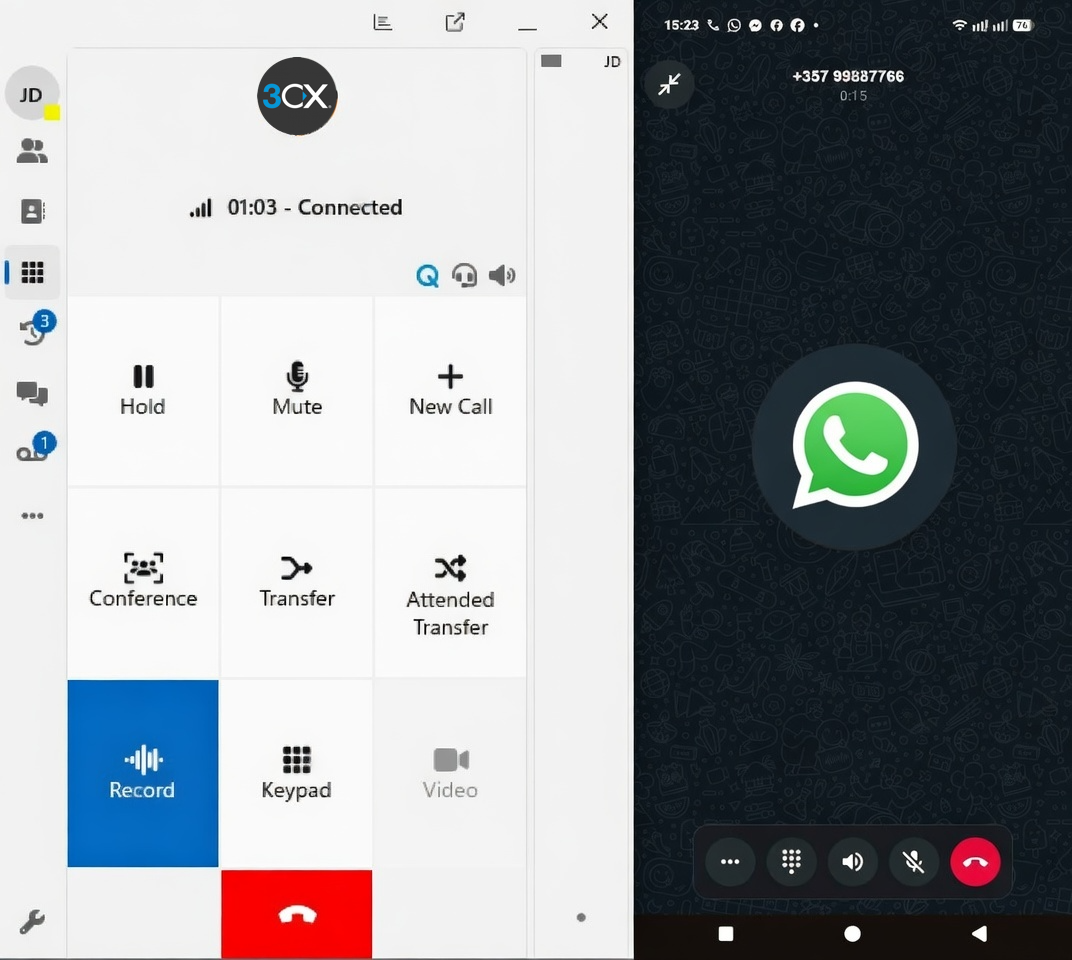
3CX's setup flow is technical, but the business outcome is simple: WhatsApp callers can land in the same call handling structure as normal phone calls.
Why SMBs Should Care
The value is not that WhatsApp is fashionable. The value is reducing friction.
When customers are already comfortable with WhatsApp, asking them to switch channels can slow down sales and support. If a business can receive those calls inside 3CX, staff can answer from the tools they already know, managers can retain better visibility, and the company can avoid informal one-to-one WhatsApp handling that disappears when an employee is away.
This is especially relevant for:
- Retailers and service businesses that get quick customer questions through WhatsApp.
- Clinics, schools, and professional offices that need better call routing and accountability.
- Companies with mobile teams that still need central call control.
- Businesses serving diaspora customers or overseas suppliers who use WhatsApp heavily.
The MSP View: Useful, But It Needs Design
This is not a feature to switch on casually. WhatsApp Business, Meta configuration, SIP routing, user permissions, queue design, call recording rules, and after-hours handling all need to be planned properly.
Blue Chip Technologies would treat this as part of the wider phone-system design, not as a standalone gadget. The right questions are:
- Which WhatsApp number should receive calls?
- Should calls go to reception, sales, support, or an AI receptionist first?
- What happens after hours?
- Which calls should be reported on or recorded?
- How does this fit with existing SIP trunks and mobile users?
- Who owns WhatsApp Business account access and security?
Bottom Line
3CX WhatsApp inbound calling is a practical step toward unified communications for SMBs. It gives customers another easy way to reach the business while keeping staff inside a managed phone system instead of scattering important calls across personal devices and informal chats.
For businesses in Trinidad and Tobago that already rely on WhatsApp for customer contact, this is worth evaluating as part of a 3CX V20 roadmap, especially if the business wants better routing, cleaner support workflows, and more visibility into customer communications.
Source: 3CX, WhatsApp Inbound Calls.