AV Networks Need Timing, Not Just Bandwidth
A business can have fast switches, modern cabling, and a strong internet connection and still have poor audio or video performance. For normal office traffic, a few milliseconds of variation may go unnoticed. For live audio, video walls, training rooms, boardrooms, houses of worship, hospitality spaces, and event environments, timing problems are much harder to hide.
Ubiquiti recently published an article on UniFi Enterprise Audio Video Switching, focused on deterministic timing, Precision Time Protocol, low-latency AV transport, and UniFi Network visibility. The product announcement is aimed at professional AV deployments, but the wider lesson is useful for Trinidad and Tobago businesses: AV networks should be designed as managed infrastructure, not improvised add-ons.
Why AV traffic is different
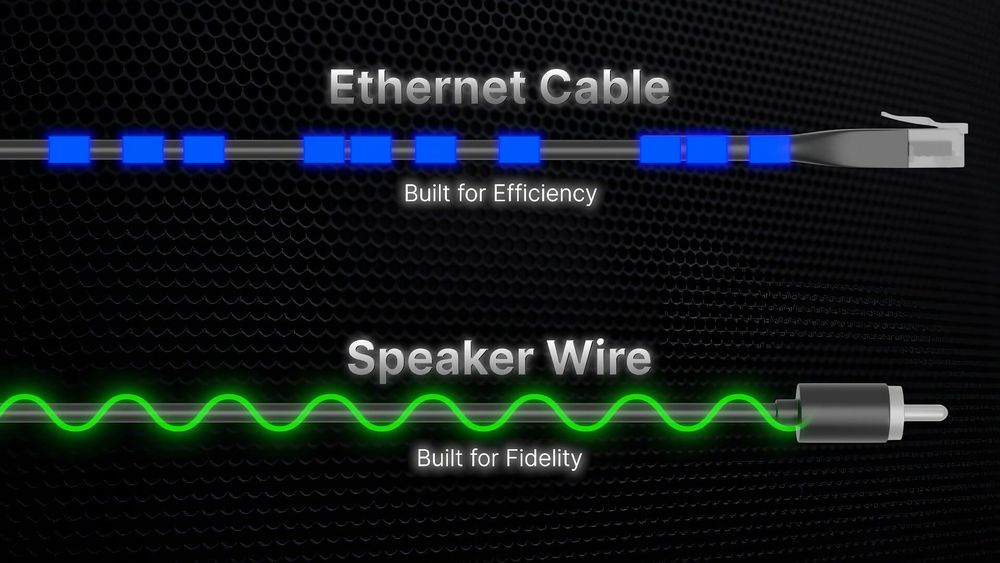
Traditional office networking is usually judged by reachability and speed. Can users get online? Are cloud apps responsive? Is the Wi-Fi stable? Those questions still matter, but AV systems add another requirement: synchronization.
When video displays, speakers, encoders, decoders, controllers, and production devices are not working from a reliable timing foundation, the result can be distracting:
- audio that feels slightly out of sync
- screens that do not change together
- unstable video-wall behaviour
- conference-room dropouts
- intermittent issues that only appear during live use
- troubleshooting that turns into guesswork
That is why AV over IP should not simply be plugged into whichever spare network ports are available.
UniFi EAV Switching points to a managed AV direction
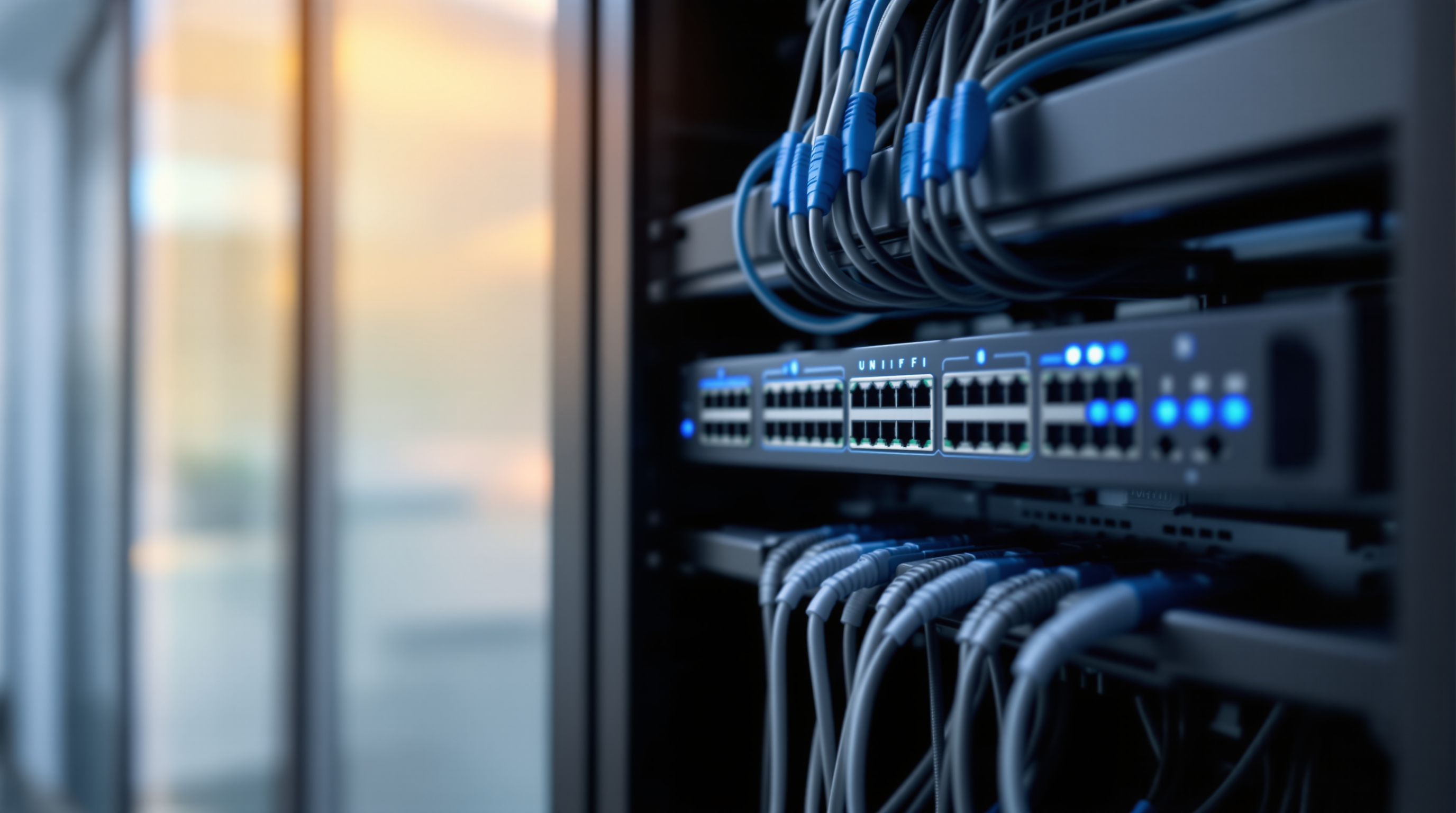
Ubiquiti's article highlights UniFi Enterprise Audio Video Switching with deterministic timing, PTP support, low-latency correction across network hops, and compatibility with professional AV standards such as Dante, AES67, SDVoE, and SMPTE ST 2110 workflows.
For a business owner, the important point is not the protocol list. The important point is that AV systems increasingly depend on the network behaving predictably.
That requires the right switches, the right cabling, the right VLAN design, the right multicast handling, and a support team that can actually see what is happening when something feels wrong.

Visibility matters as much as hardware
One of the most practical parts of the UniFi approach is management visibility. UniFi Network can help operators view port status, topology, latency, device behaviour, historical changes, and performance trends from a central interface.
That matters because many AV problems are intermittent. A boardroom may work during testing and fail during a client presentation. A display wall may look fine until more endpoints are added. Audio may drift after a topology change.
A managed platform gives support teams better questions to answer:
- Which switch ports are carrying the AV traffic?
- Is the topology correct for the room or venue?
- Are endpoints seeing consistent timing?
- Is multicast configured properly?
- Did a port, cable, firmware version, or device change before the issue started?
- Can we separate AV traffic from guest Wi-Fi, cameras, phones, and general office devices?
Without that visibility, every AV issue becomes slower and more expensive to troubleshoot.
Good design prevents daily support pain
For SMBs, AV networking is becoming more common. It is no longer limited to specialist venues. Businesses now use network-connected displays, meeting-room systems, digital signage, IP cameras, access control, speakers, and live-streaming equipment.
If all of that traffic shares a flat, undocumented network, support gets messy quickly.
A better design may include:
- separate VLANs for AV, cameras, guest Wi-Fi, staff devices, and management
- switches sized for the right PoE and uplink capacity
- multicast and IGMP planning where required
- documented port maps and device naming
- firmware lifecycle management
- clear backup and recovery procedures
- monitoring for switch, port, and device health
- remote support access through approved management tools
The goal is not to overcomplicate the network. The goal is to make important systems predictable.
This is especially important for client-facing spaces
AV failures are visible. Staff may tolerate a slow file download for a few minutes, but a failed conference room, frozen display, choppy livestream, or out-of-sync audio can embarrass the business in front of clients, guests, or staff.
That is why AV networks deserve the same discipline as Wi-Fi, firewalls, servers, and backups. The environment should be planned, labelled, monitored, and supportable.
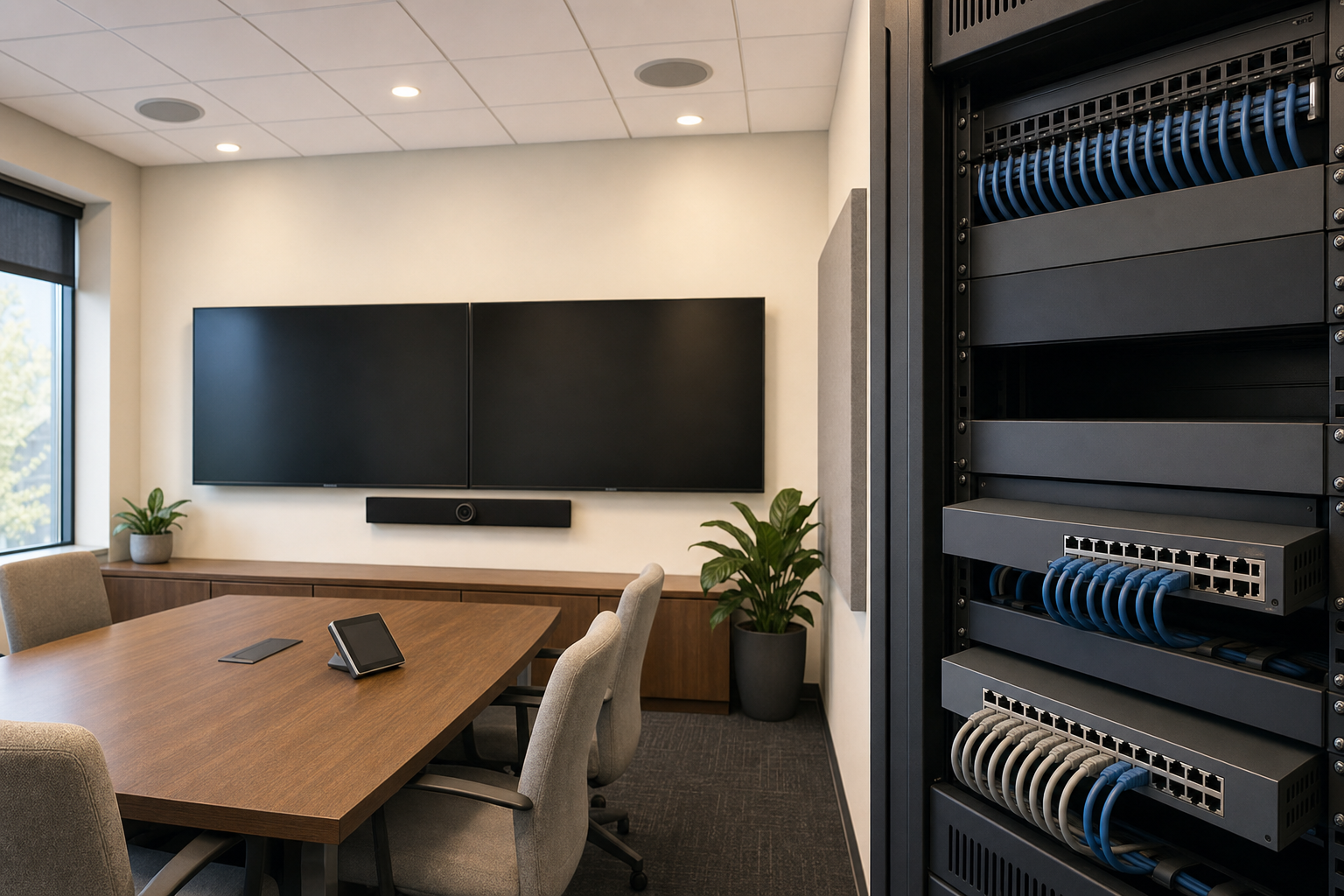
For hotels, training rooms, schools, offices, retail environments, boardrooms, restaurants, event spaces, and houses of worship, a managed AV network can make the difference between a system that only works when the installer is present and one that remains supportable after daily use begins.
Where Blue Chip can help
Blue Chip designs and supports UniFi-based business networks for clients that want practical reliability and clearer management.
That can include:
- UniFi switching and gateway selection
- VLAN and segmentation planning
- Wi-Fi, camera, access-control, and AV network separation
- PoE budgeting for access points, cameras, phones, and AV devices
- UniFi Network monitoring and documentation
- troubleshooting for switch ports, uplinks, roaming, and device connectivity
- firmware and configuration management
- remote support and managed IT operations
- coordination with AV installers, electricians, and facilities teams
When AV systems depend on the network, IT and AV planning need to meet early. That is where a managed approach saves time.
The takeaway
Ubiquiti's EAV Switching announcement is a useful reminder that modern business networks are carrying more than laptops and printers. They now support communication, collaboration, surveillance, access control, signage, audio, video, and guest services.
Bandwidth still matters, but timing, visibility, segmentation, and supportability matter too.
If your business is adding meeting-room technology, displays, speakers, cameras, or larger AV systems, review the network before the installation becomes business-critical. A well-planned UniFi environment can make those systems easier to manage, easier to support, and more reliable when people are depending on them.
Source: Ubiquiti Blog — Introducing EAV Switching.