Quote Emails Should Be Templates, Not One-Off Messages
A quote does not end when the pricing is calculated. The email that delivers the proposal, requests approval, asks for payment, or confirms the order is part of the sales process too.
For many small and mid-sized businesses in Trinidad and Tobago, that communication is still handled manually. One salesperson writes a polished message. Another sends a short note with missing context. Someone forgets to copy purchasing. Someone else attaches the wrong document or leaves out the next step.
That inconsistency slows down deals and creates avoidable follow-up work.
QuoteWerks' recent tips article on email templates and snippets is useful because it highlights a practical control point: standardising the messages that go out with quotes, orders, invoices, payment requests, and customer follow-ups.
Why quote emails deserve structure
Customers judge a proposal by more than the numbers. They also notice whether the message is clear, complete, and easy to act on.
A managed quote email should answer simple questions:
- What is being sent?
- What does the customer need to review?
- What is the next step?
- Who should they contact with questions?
- Is approval, signature, payment, or purchase-order action required?
- Are the right internal teams copied for visibility?
When every salesperson writes from scratch, quality depends on memory and available time. Templates make the expected standard repeatable.
Where QuoteWerks helps
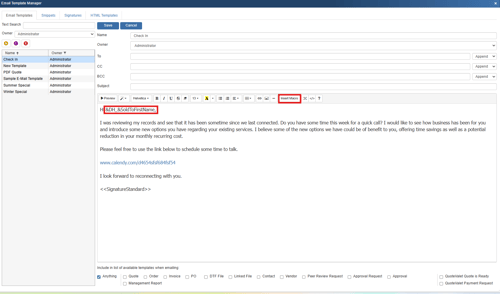
QuoteWerks email templates let teams prepare reusable messages for common quote and proposal workflows. Instead of typing the same content repeatedly, users can select the right template from the send-email window and start from a controlled message.
That matters for businesses that send different types of communication, such as:
- initial quote delivery
- revised quote follow-up
- approval requests
- payment requests
- order confirmations
- invoice communication
- procurement handoff messages
- renewal or re-order reminders
QuoteWerks also supports template macros, so the message can pull in relevant quote, customer, document, or user details without requiring staff to copy and paste them manually.
Snippets reduce duplicated wording
Templates solve one part of the problem. Snippets solve another.
A snippet is reusable content that can be maintained centrally and inserted into multiple templates. That is useful when the same block of wording appears in many customer messages.
For example, a business may want standard language for:
- payment instructions
- delivery expectations
- warranty notes
- implementation next steps
- support contact details
- purchase-order requirements
- recurring-service explanations
- finance or procurement disclaimers
If that wording changes, updating one snippet is cleaner than hunting through multiple templates and hoping every version is corrected.
Better internal routing
The QuoteWerks article also points out a small but important operational detail: templates can include default To, CC, and BCC fields.
That can help teams avoid common breakdowns. A service manager can be copied when a quote includes implementation work. Purchasing can be copied when a payment request is sent. Finance can receive visibility when a customer accepts or pays. Management can be included for specific approval flows.
This is not about copying everyone on every message. It is about making the right communication automatic for the right workflow.
Practical examples for local SMBs
For a Trinidad and Tobago business, QuoteWerks email templates and snippets can support everyday sales discipline without making the sales team slower.
A distributor could standardise quote delivery messages so customers always see payment terms, delivery expectations, and the correct contact details.
An IT provider could use snippets for hardware availability, implementation scheduling, support scope, and recurring-service terms.
A project-based business could use templates to separate estimate delivery, formal approval, deposit request, and work kickoff communication.
A finance or operations team could make sure the correct internal people are copied when a quote moves from sales conversation to fulfilment.
The value is simple: fewer one-off messages, fewer missing details, and less chasing after the quote has already been sent.
What Blue Chip looks for in a rollout
Blue Chip's approach is to treat quoting communication as part of the business process, not just an email formatting exercise.
Before rolling out templates, we would normally review:
- current quote and proposal stages
- common customer questions after receiving a quote
- approval and payment requirements
- internal handoff points between sales, finance, purchasing, and service teams
- branding and tone standards
- which messages should be user-owned, public, or system-controlled
- which fields can safely be automated with macros
- how the process connects to CRM, accounting, procurement, or helpdesk workflows
The aim is not to create a library of long, robotic emails. The aim is to give staff a better starting point so communication stays professional even on busy days.
A simple first step
Start with the three messages that cause the most repeat work.
For many businesses, that will be quote delivery, quote revision, and payment or approval request. Write them clearly. Add the correct next steps. Include the right internal routing. Then test them with real customer scenarios.
Once those messages are stable, snippets can help standardise the common blocks that appear across several templates.
That is where QuoteWerks becomes more than a quoting tool. It helps turn sales communication into a repeatable workflow that supports faster decisions, cleaner handoffs, and a more professional customer experience.
Source: QuoteWerks — Tips & Tricks December 2025: Email Templates and Snippets.