3CX AI Agents Need Capacity Planning Before They Answer Calls
AI call handling sounds exciting until the first busy morning when callers stop getting answers. If an AI receptionist or AI agent is expected to understand a caller, ask questions, and transfer the call to the correct person, the service behind that AI must have enough capacity to respond in real time.
3CX recently published technical guidance on avoiding OpenAI rate limits for AI Agents. The article is detailed, but the business lesson is straightforward: AI phone features should be planned like production communications infrastructure, not like an experiment someone switches on and hopes will scale.
For Trinidad and Tobago SMBs, this matters because phone calls are still where many sales, support requests, appointments, deliveries, and urgent issues begin.
AI phone agents depend on outside capacity
A traditional call flow is usually predictable. The PBX receives the call, plays prompts, checks office hours, and sends the caller to an extension, ring group, queue, voicemail, or mobile app.
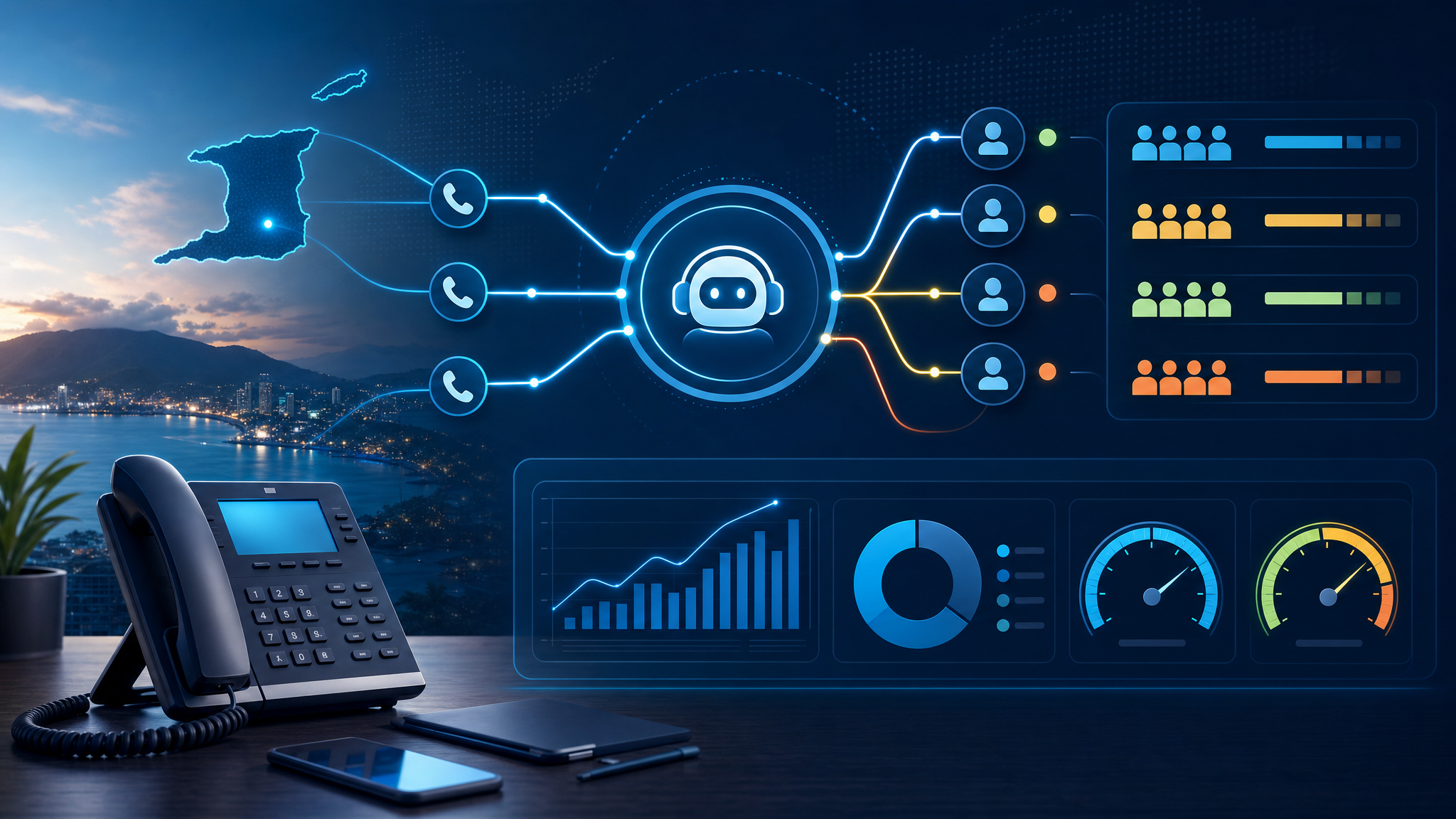
AI agents are different. They may need to listen, interpret intent, generate a response, and decide where to transfer the call. That can involve model requests, token usage, request-per-minute limits, and usage tiers from an AI provider.
If those limits are too low, the caller may experience silence, delay, failed responses, or broken routing. From the customer's point of view, the business phone system simply did not work.
The practical risk: busy periods
Rate limits often show up when the system is under pressure. A small team may test an AI call flow with one or two calls and everything looks fine. Then month-end, lunch time, a promotion, school pickup time, or a service interruption sends more callers into the system at once.
That is when capacity planning matters.
Businesses should think through questions such as:
- How many simultaneous AI-handled calls are realistic?
- What happens if the AI service reaches its limit?
- Which callers should go to a normal queue instead?
- How long can a caller wait before the system falls back?
- Are prompts and knowledge sources making each AI interaction heavier than necessary?
- Who reviews logs when AI call handling fails?
- Is the AI provider account on an appropriate usage tier for business use?
The goal is not to avoid AI. The goal is to avoid making the phone system fragile.
AI features still need call-flow design
A reliable 3CX AI Agent setup should fit into the wider phone-system design. That includes SIP trunks, IVR menus, call queues, ring groups, office hours, holidays, voicemail, mobile apps, reporting, and escalation rules.
AI can be useful for understanding caller intent, collecting basic information, transferring calls, and reducing repetitive front-desk work. But it should not become a single point of failure.
A sensible rollout may include:
- testing the AI agent with realistic call examples
- keeping clear fallback routes to staff or queues
- limiting the first rollout to a specific department or number
- reviewing call logs and failed interactions
- checking model usage and rate-limit warnings
- simplifying prompts and knowledge sources where possible
- training staff on what the AI agent can and cannot do
This is especially important for companies where missed calls mean missed revenue or poor customer service.
Do not treat AI calling as a one-time setup
AI communication tools will change quickly. Models, usage tiers, pricing, feature names, and provider limits can all change over time. A business that depends on AI call handling should review it periodically, just like firewall rules, backups, SIP trunks, or endpoint security.
That review should include technical checks and business checks. Is the AI answering the right calls? Are customers getting to the right team? Are staff correcting bad transfers? Are call volumes growing? Are rate limits still appropriate?
A phone system is not successful because the demo worked. It is successful when it behaves reliably during a normal business day.
Where Blue Chip fits
Blue Chip Technologies helps businesses plan, deploy, and support 3CX and VoIP environments across phone-system design, SIP trunks, call queues, IVR routing, mobile and web apps, CRM integration, reporting, security, monitoring, and user support.
For AI phone features, our view is practical: start with the customer journey, design safe fallback paths, test with real call patterns, and monitor the system after go-live. AI can improve communication, but only when it is backed by proper planning and support.
If your business is considering AI receptionists, AI agents, transcription, or smarter call routing in 3CX, now is the time to review capacity, call flows, and support processes before customers depend on it.
Source: 3CX Blog — Avoiding Rate Limits for AI Agents.