
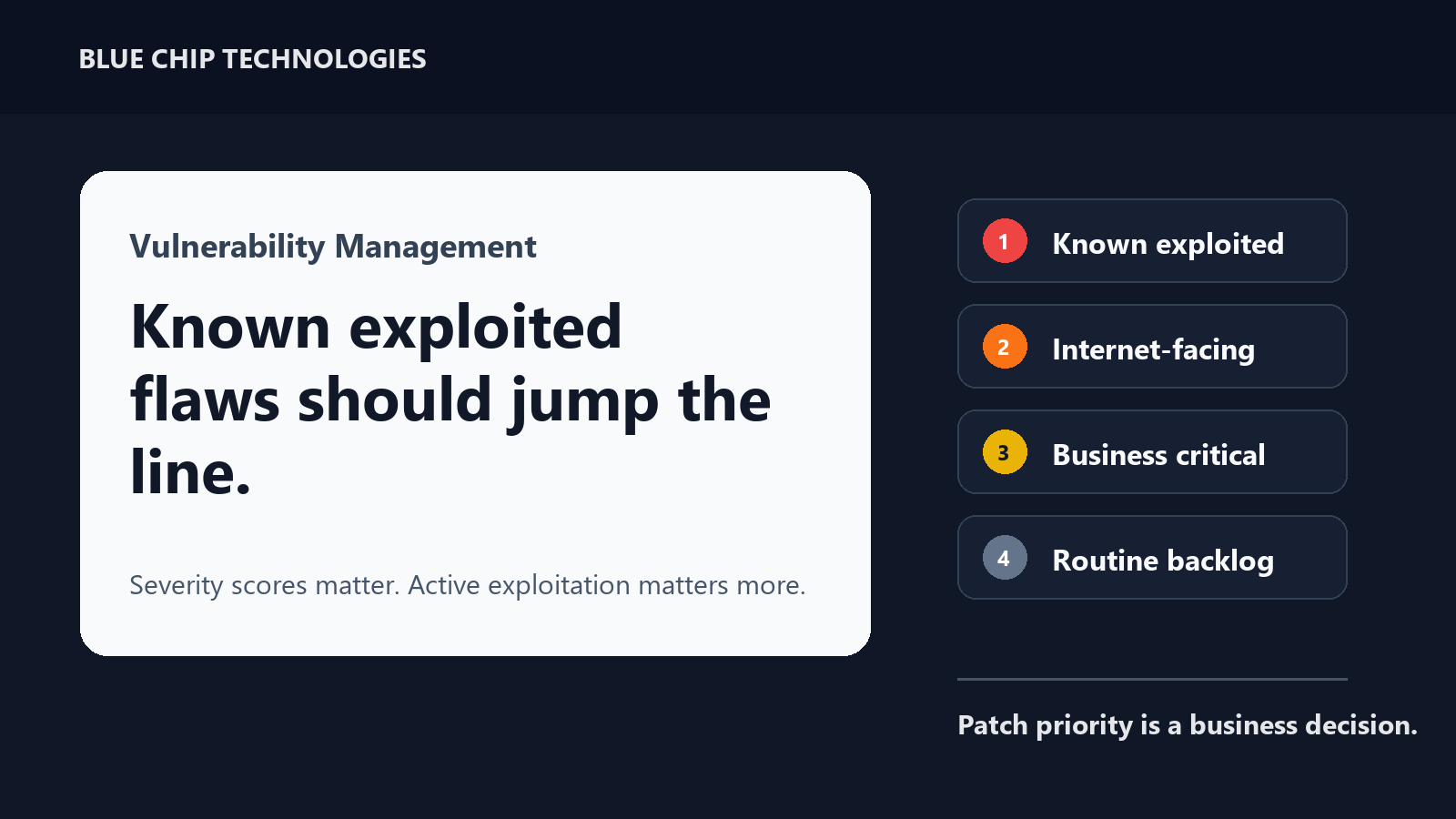
Actively Exploited Vulnerabilities Need Their Own Patch Queue
Not every vulnerability should sit in the same patch backlog.
A high severity score is important, but it is not the whole story. Once a vulnerability is known to be exploited in the wild, the conversation changes. That flaw is no longer theoretical. It belongs in a separate, faster queue with an owner, a deadline, and proof that the fix landed.
CISA’s Known Exploited Vulnerabilities catalog exists for exactly this reason. It gives defenders a practical signal: attackers have been observed using these weaknesses, so organizations should use the catalog as an input to vulnerability-management prioritization.
The mistake many businesses make
Small and mid-sized businesses often handle patching as one large pile:
- Windows updates
- firewall updates
- browser updates
- NAS firmware
- VPN appliances
- remote access tools
- business applications
- server packages
That backlog gets sorted by convenience, downtime windows, or whatever looks loudest in the dashboard. The problem is that attackers do not care about your maintenance calendar.
If a vulnerability is already being exploited, it needs different treatment from a routine update.
What a separate KEV queue should include
A practical actively-exploited vulnerability process does not need to be complicated. It should answer five questions quickly:
- Do we run the affected product anywhere?
- Is it internet-facing, remotely reachable, or exposed through VPN/remote access?
- Is there a vendor patch or mitigation?
- Who owns the remediation?
- How will we prove it was fixed?
The proof matters. "The update probably installed" is weak. Better evidence includes version checks, endpoint reporting, vulnerability-scan results, vendor-console status, or a direct validation command where appropriate.
Prioritize exposure, not just score
A vulnerability on a public firewall, VPN appliance, remote support tool, mail server, or identity system can be more urgent than a higher-scoring issue buried inside a low-risk workstation app.
Good prioritization usually looks like this:
- Known exploited and exposed to the internet
- Known exploited on identity, remote access, security, backup, or management systems
- Known exploited on common endpoints and browsers
- Critical vulnerabilities on internet-facing systems
- High severity vulnerabilities on business-critical systems
- Routine patch backlog
This is not about ignoring the rest. It is about admitting that the first group can turn into a compromise while everyone is still debating the normal maintenance window.
What Blue Chip recommends
For managed environments, keep a small "hot patch" lane separate from routine monthly patching. When a known-exploited item appears, check the environment, identify affected assets, apply the fix or mitigation, then record the verification.
That record should include:
- affected systems found
- remediation performed
- reboot or service impact, if any
- verification evidence
- remaining exceptions
- next review date
The goal is boring but important: no mystery, no assumption, no "we think it patched."
The practical takeaway
Vulnerability management is not just installing updates. It is deciding what must move first.
If attackers are already using a flaw, it should not wait behind routine patch noise. Give known-exploited vulnerabilities their own queue, their own owner, and their own verification trail.
Source: CISA - Known Exploited Vulnerabilities Catalog.