
GFI Kerio Works Best When It Is Managed as a Stack
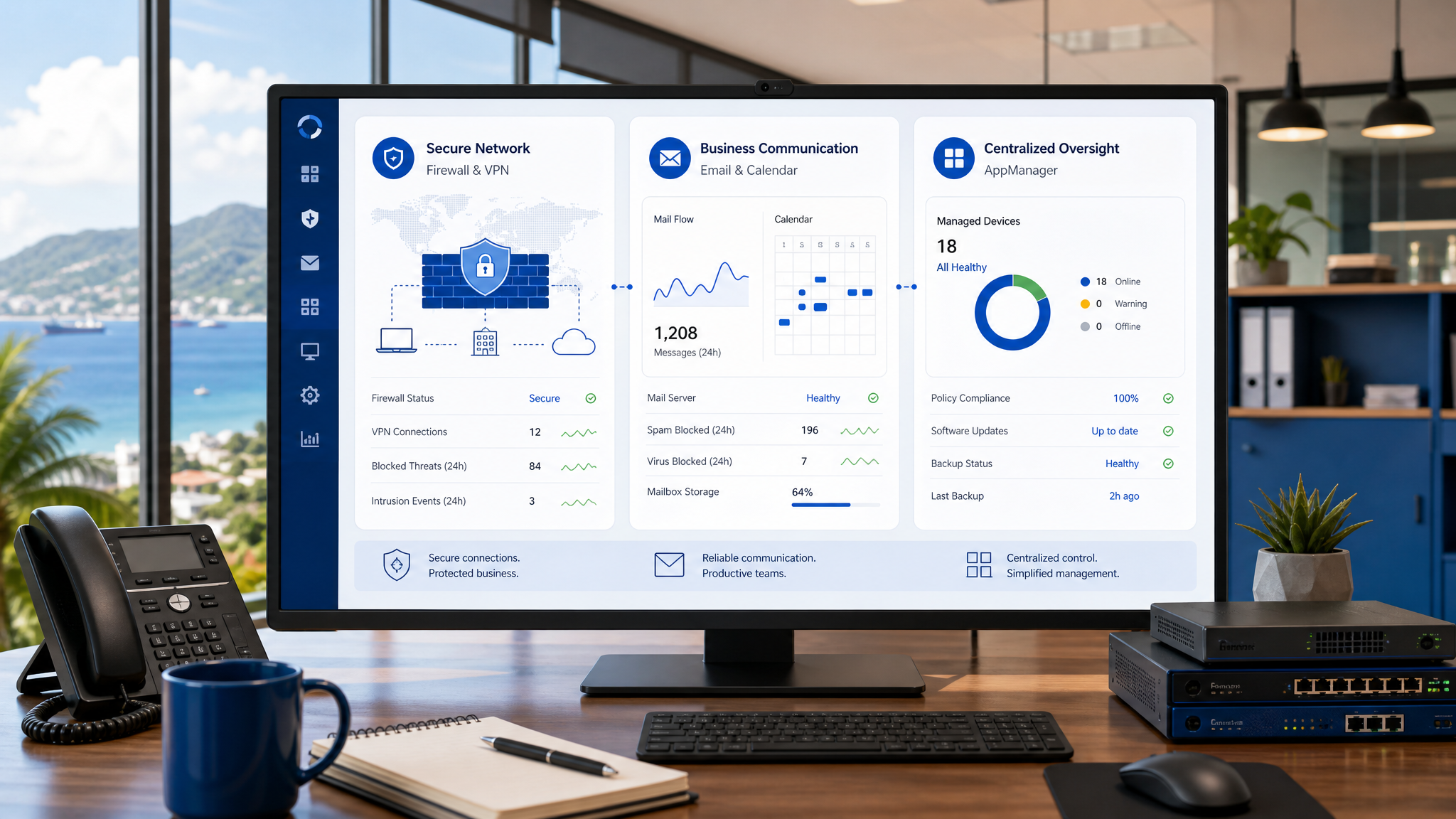
GFI Software recently announced a Kerio channel strategy update for North America, naming Zebra Systems as the new authorized distributor for the Kerio product family in that region. The announcement is mainly about distribution and partner support, but the useful point for small and medium-sized businesses is broader: Kerio is not just one product. It is a stack of email, security, firewall, VPN, and management tools that needs proper setup and ongoing care.
For Trinidad and Tobago SMBs, that matters. A firewall, an email platform, and a management console can all look fine on day one. The real value comes from keeping them configured, patched, monitored, backed up, and aligned with how the business actually works.
The Kerio stack covers practical SMB needs
The GFI article highlights several products in the Kerio and AppManager family:
- GFI KerioControl for firewall protection, intrusion prevention, gateway antivirus, VPN, web filtering, and application control
- GFI KerioConnect for business email, calendars, contacts, and collaboration
- GFI AppManager for centralized oversight of multiple Kerio deployments
- GFI AppManager AI for management automation, proactive insights, and security support
Those are everyday IT needs, not abstract enterprise problems. Many local offices need secure remote access, cleaner email management, reliable internet controls, and an easier way to see whether systems are healthy.
The mistake is treating each tool as a separate purchase. A business gets better results when the tools are designed and managed as one operating environment.
Firewall and VPN rules need ownership
KerioControl can help protect the edge of the network, but the quality of a firewall depends on the rules behind it.
A small business should know:
- who is allowed to connect by VPN
- which services are exposed to the internet
- whether old vendor access has been removed
- which websites or applications should be limited
- how branch offices or remote users are connected
- where logs and alerts are reviewed
- how changes are approved and documented
Firewall rules tend to accumulate over time. A temporary vendor access rule becomes permanent. A former employee remains in a VPN group. A port opened for testing stays open. Managed IT support is what keeps those small gaps from becoming long-term exposure.
Email needs more than mailboxes
KerioConnect gives SMBs another option for business email, calendars, contacts, and collaboration. That can be valuable for companies that want predictable licensing, flexible deployment, or an alternative to a full Microsoft 365 move.
But email still needs controls around it.
Businesses should plan for:
- mailbox backup and restore testing
- spam and malware filtering
- password policy and account lifecycle management
- shared mailbox ownership
- mobile device access
- archiving and retention
- DNS records such as SPF, DKIM, and DMARC
- user training for suspicious links and payment-change requests
Email is usually where staff, suppliers, customers, and attackers all meet. Whether a business uses Microsoft 365, Google Workspace, KerioConnect, or another platform, it needs clear ownership and support.
Central management makes sense when it reduces blind spots
GFI positions AppManager as a centralized management console for Kerio deployments, with AppManager AI adding automation and proactive insight. That direction is useful because many SMB environments suffer from fragmented visibility.
One person checks the firewall. Another checks email. Someone else handles a VPN issue. A support ticket gets closed, but the wider pattern is missed.
Central oversight can help answer better questions:
- Are all client firewalls online and healthy?
- Which systems need attention before users complain?
- Are security events being reviewed consistently?
- Are recurring VPN or email issues pointing to a larger problem?
- Are updates and support renewals being tracked?
- Can an MSP support multiple sites without logging into each one separately?
AI can help with noise reduction and prioritization, but it should sit inside a managed process. Alerts still need ownership, escalation, documentation, and follow-through.
What Blue Chip would review before recommending Kerio
Kerio can be a good fit for some SMBs, but the right answer depends on the environment. Before recommending a firewall, email, or management platform, Blue Chip would normally review:
- number of users and sites
- internet circuits and failover needs
- remote access requirements
- current email platform and mailbox sizes
- backup and restore expectations
- compliance or retention needs
- endpoint security and patching posture
- support model and response expectations
- budget predictability
- whether cloud, on-premise, or hybrid deployment makes the most sense
That review prevents a product decision from becoming a guess.
The practical takeaway
The GFI Kerio family is strongest when it is treated as business infrastructure. The firewall protects access. The email platform carries daily operations. The management layer helps keep multiple systems visible. The AI layer can assist, but it does not replace disciplined support.
For SMBs in Trinidad and Tobago, the question is not simply whether KerioControl, KerioConnect, or AppManager can run. The question is whether the business has the right design, rules, backups, monitoring, and support around them.
Blue Chip can help assess the current environment, compare Kerio against Microsoft 365 or other options, deploy the right controls, and manage the stack after go-live. That is where software becomes a reliable service instead of another system someone has to remember to check.
Source: GFI Software, GFI Software Elevates Kerio Channel Strategy, Appointing Zebra Systems as New Authorized Distributor for North America.