
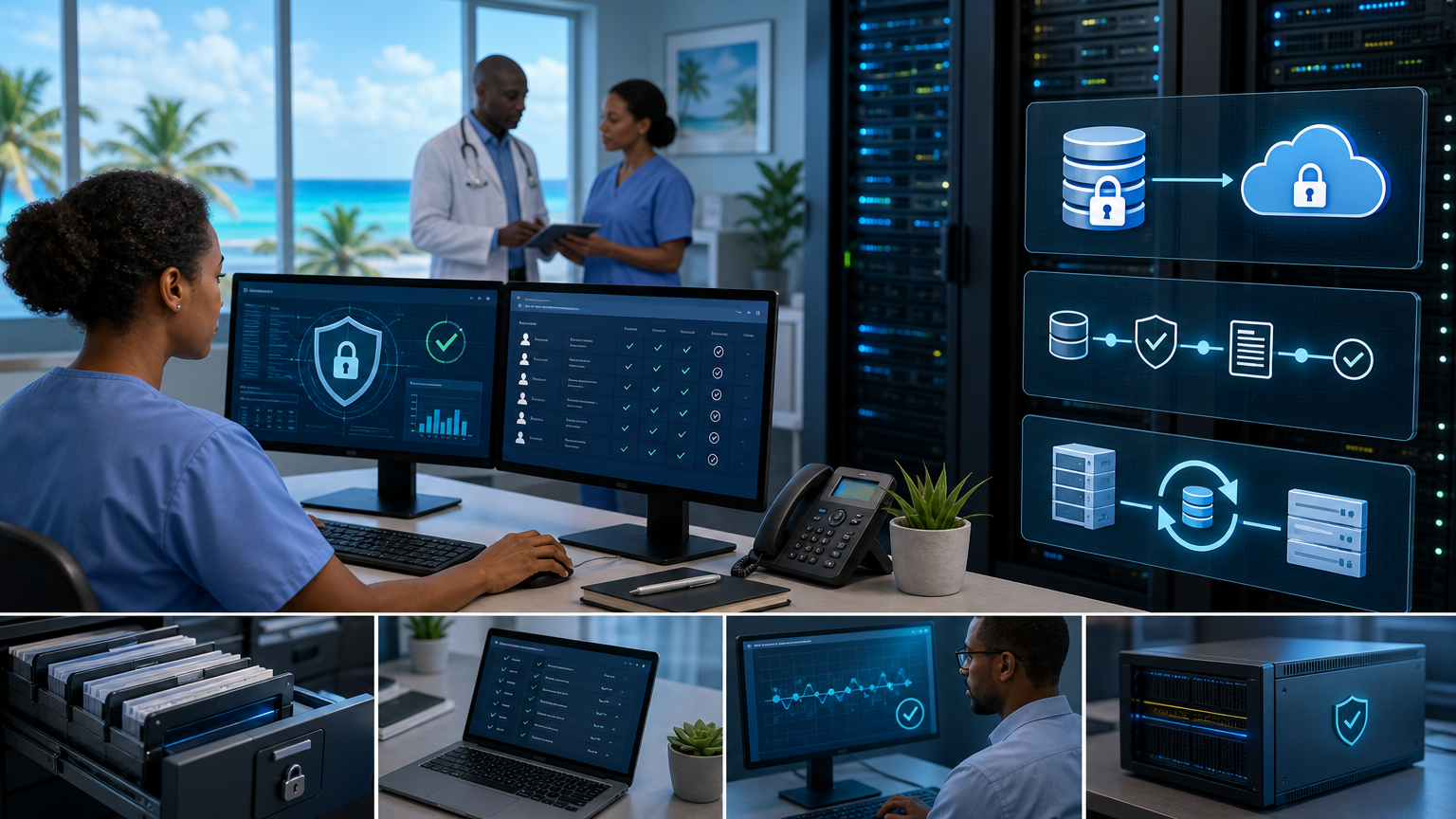
Synology recently published a healthcare-focused article on protecting sensitive patient data with ActiveProtect. The source frames the discussion around HIPAA, which is a U.S. regulation, so Trinidad and Tobago businesses should not treat this as local legal advice. The practical lesson still matters: healthcare data protection is not credible unless the organisation can prove who accessed data, how long it is retained, whether backups are protected from tampering, and whether clean recovery has been tested.

Synology's source article frames healthcare data protection around audit logs, access control, resilience, and tested recovery.
Medical offices, clinics, pharmacies, labs, insurance teams, and service providers all depend on records that are both sensitive and operationally critical. If those records are lost, encrypted by ransomware, exposed, or restored from an untested copy, the impact is bigger than inconvenience. It can affect patient trust, business continuity, compliance posture, and the ability to keep serving people.
The Practical Healthcare Risk
The weak point for many small and medium-sized healthcare organisations is not only cyber defence. It is the lack of evidence around recovery. Teams may have backups, but no clear audit trail. They may keep years of data, but without a defined retention policy. They may allow broad restore access, but without least-privilege controls. They may assume a backup works, but never run a proper recovery test.
That gap becomes painful during an incident, insurance review, vendor assessment, or regulatory question. The business needs to answer practical questions quickly: where is patient data stored, who can access it, what happened to it, can it be restored, and how do we know the restored copy is clean?
Where Synology ActiveProtect Fits
Synology positions ActiveProtect as a purpose-built data protection appliance for centralising backup, recovery, and security controls. In the healthcare article, Synology highlights audit logs and reports, activity summaries, advanced system logs, and log forwarding so organisations can review activity and uncover hidden risks.
Access control is just as important. Synology says ActiveProtect supports delegated user permissions based on least privilege, with users assigned access to servers, backup management, restore functions, or view-only roles. It also supports centralised user management through Windows AD and LDAP, plus SSO and existing MFA methods configured on the organisation's SSO or MFA server.
For ransomware resilience, the article points to built-in immutability, air-gapped backup copies, self-healing, automatic backup verification, and a built-in hypervisor for disaster recovery testing. Synology also notes that ActiveProtect can verify backups by capturing a video, giving IT teams stronger evidence that an accurate copy is preserved.
Retention and Recovery Are Business Controls
Healthcare data cannot be treated like ordinary office files. Retention rules, backup copies, access permissions, and restore procedures need to be documented and reviewed. Synology's source says ActiveProtect supports retention policies and cloud or on-premises remote storage options for safeguarding backup copies or storing tiered data. It also notes AES-256 is used when data is transferred to a remote storage site.
For local healthcare organisations, this supports a more disciplined backup model: keep what must be kept, protect it from unauthorised change, restrict who can restore it, send logs where they can be reviewed, and test recovery before the business is under pressure.
Blue Chip's View
For Trinidad and Tobago healthcare and professional services SMBs, the takeaway is straightforward: patient and client data protection needs operational proof. Policies and antivirus are not enough. The backup environment must show retention control, access control, tamper resistance, audit visibility, and tested recovery.
Blue Chip Technologies can help review where sensitive records live, design retention and backup practices, configure Synology ActiveProtect controls, integrate identity and MFA where appropriate, test restores, and produce the evidence management needs during an incident or review. The goal is practical: keep sensitive data protected, recoverable, and managed without pretending every small organisation has an enterprise compliance department.
Source: Synology, Safeguard your healthcare data with Synology ActiveProtect.