UniFi Enterprise AV Switching: Treat Audio and Video Like Critical Network Traffic
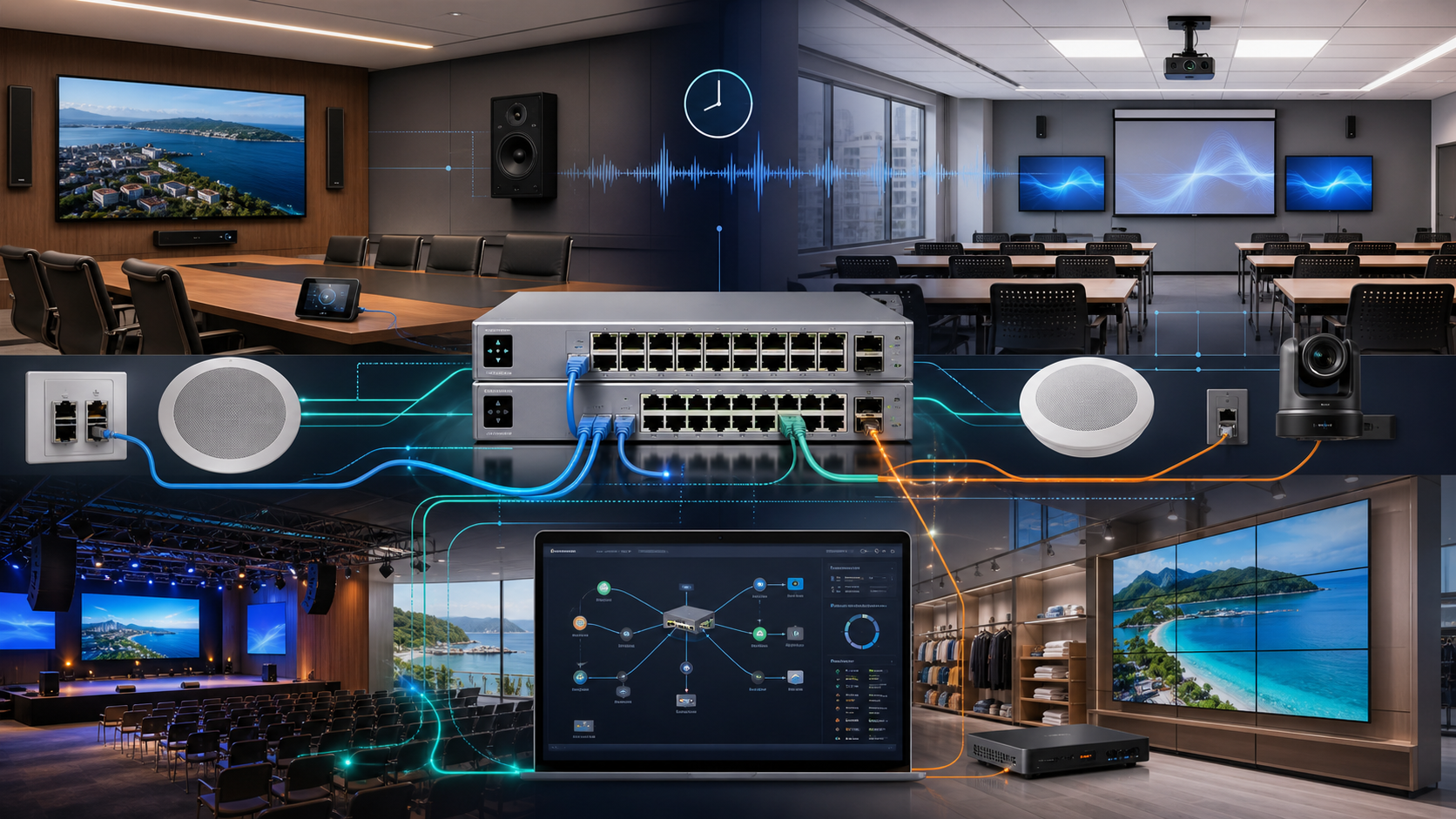
Audio and video systems are no longer separate from the network. Meeting rooms, training spaces, retail displays, houses of worship, hospitality areas, and small event venues increasingly depend on IP-connected displays, speakers, microphones, cameras, encoders, and control systems.
That shift is useful, but it also raises the standard for the network. A normal data network can tolerate small variations in timing. Professional audio and video cannot. If timing drifts, the business sees it as lip sync issues, delayed audio, unstable playback, or a room that feels unreliable even though the cable and switch lights look fine.
Ubiquiti recently introduced UniFi Enterprise Audio Video Switching, focused on precise timing, low latency, standards-based AV-over-IP support, and management inside UniFi Network. For Trinidad and Tobago SMBs, the important takeaway is straightforward: AV should be designed, monitored, and supported like critical business infrastructure.
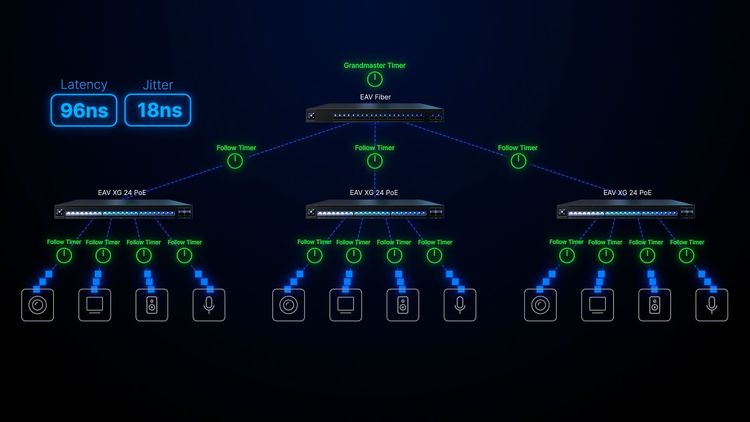
Why AV-over-IP needs more than bandwidth
It is tempting to treat AV as a bandwidth problem. Buy a fast switch, plug everything in, and assume the job is done. That approach can work for simple displays, but it becomes weak when the room needs synchronized audio, multiple endpoints, distributed video, or repeatable performance for live use.
Business AV depends on consistency. A training room display, boardroom microphone, background audio zone, and video wall may all be moving traffic at the same time. The network must keep timing predictable across every switch hop, not only deliver enough raw throughput.
Ubiquiti's EAV direction is built around deterministic timing using Precision Time Protocol, with support for clocking behavior across switch topologies. In plain terms, the network gives AV devices a shared sense of time, so endpoints can stay synchronized as the deployment grows.
Where this matters locally
Most SMBs do not need stadium-scale AV. They do need rooms and customer-facing spaces that work every time.
- Conference rooms where microphones, speakers, screens, and cameras must stay in sync during hybrid meetings.
- Training rooms that need reliable audio and display distribution without a pile of special-purpose wiring.
- Retail and hospitality spaces with digital signage, video walls, or distributed music zones.
- Churches, schools, and event spaces that need clean audio and video without treating every service as a one-off production job.
- Multi-room offices where IT has to manage AV equipment without becoming an AV detective every time something glitches.
The network design should match the business risk. If the room is only used once a month, a simple setup may be enough. If it supports sales presentations, management meetings, customer-facing signage, or paid events, the AV network deserves proper planning.
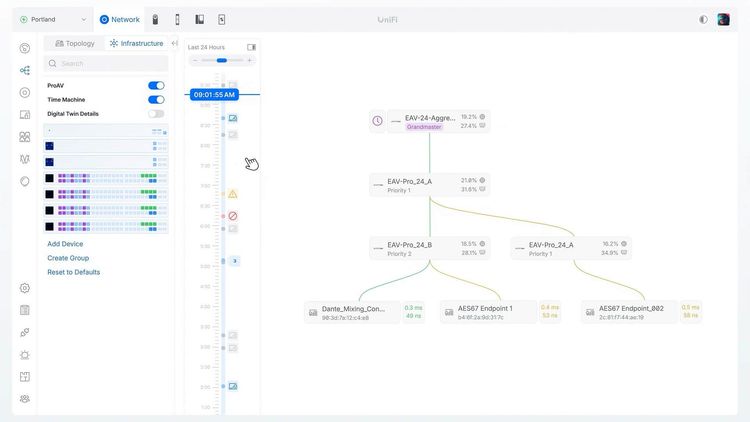
Management visibility is the real MSP advantage
The most useful part of bringing AV into a managed network platform is visibility. Traditional AV issues often hide in a grey area between IT and the AV installer. The display is on, the switch port is up, the endpoint appears connected, but no one can quickly explain where timing, multicast, or topology problems started.
UniFi Network gives operators a practical management layer for the network side of the AV estate. Ubiquiti highlights latency visibility, historical review of port and performance state, topology awareness, and upcoming multicast analysis for IGMP optimization. Those are exactly the types of tools an MSP needs to reduce guesswork.
For clients, that means support can move from “try rebooting the room” to a more useful process:
- confirm which endpoints are connected and where
- check whether AV traffic is flowing through the expected switches
- review recent port or topology changes
- identify timing or latency patterns before blaming the device
- separate network faults from endpoint or configuration faults
Standards matter because AV stacks are mixed
Most real AV environments are not built from one vendor forever. A business may already have Dante audio, AES67-compatible devices, NDI video workflows, Q-SYS control, or other professional equipment. Any serious AV-over-IP network has to respect that mixed reality.
Ubiquiti positions EAV Switching around industry-standard AV-over-IP workflows, including support for SMPTE ST 2110, Dante, AES67, SDVoE-ready video transport, and interoperability across professional AV ecosystems. That matters because the switch fabric should not force the client into a dead end.
The planning question is not “can we plug it in?” It is “can we support this environment cleanly over the next few years?” Standards-based switching gives the business more room to expand without replacing everything when a new room, display wall, or audio system is added.
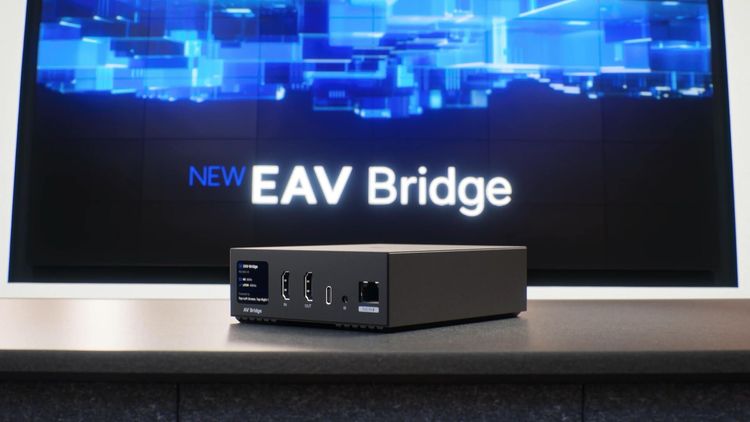
The EAV Bridge could simplify smaller deployments
Ubiquiti also presents the UniFi EAV Bridge as a way to simplify AV-over-IP deployments. The bridge combines HDMI and AES67 support, can operate as a transmitter or receiver, is powered by PoE, and integrates with UniFi Network management.
That kind of device is interesting for smaller businesses because it reduces the number of separate boxes needed to get a display or AV endpoint onto the network. It may be useful for single displays, multi-display video walls, and rooms where the business wants a cleaner path than traditional point-to-point AV cabling.
As always, the design still matters. AV-over-IP can be elegant, but only when VLANs, multicast behavior, PoE budget, switch capacity, fiber or copper uplinks, UPS protection, and support ownership are thought through before installation day.
Blue Chip's practical view
We would not recommend replacing every AV setup just because a new switch line exists. The better approach is to classify the room or space:
- Basic: single display or simple audio where standard switching is acceptable.
- Managed: meeting rooms and signage where monitoring, PoE, and clean topology matter.
- Performance-critical: live audio, video walls, distributed AV, or production spaces where timing and standards support are part of the design.
For clients already using UniFi for switching, Wi-Fi, gateways, cameras, or access control, EAV Switching may create a cleaner operational model. One management platform can cover more of the technology stack, and support teams can see more of what is happening before a room failure becomes a business interruption.
The useful lesson from Ubiquiti's announcement is not that every SMB needs enterprise AV switching today. It is that audio and video are now network services. Once a business relies on them, they should be designed with the same discipline as Wi-Fi, switching, routing, and internet resilience.
Source: Ubiquiti, “Introducing EAV Switching,” published 15 April 2026.