

CRM Email Signatures: Turn Everyday Messages Into Sales Signals
Most sales teams already send a steady stream of customer emails every day. Quotes, follow-ups, payment reminders, service updates, meeting notes, and renewal conversations all pass through inboxes.
The problem is that many of those touchpoints never connect back to the sales process. A customer may click a campaign banner, explore a service page, or show interest in an offer, but the CRM never sees it.
Rocketseed's article on Salesforce-integrated email signature software highlights an important shift: email signatures are no longer just branding blocks. When managed properly, they can become measurable CRM-connected sales signals.
Why this matters for local SMBs
For many Trinidad and Tobago businesses, the CRM is only as useful as the information inside it. If sales activity stays scattered across individual inboxes, managers get an incomplete picture.
A managed email signature platform can help close that gap by connecting everyday email engagement with customer records, campaigns, and follow-up activity.
That does not mean every business needs a complex enterprise setup. It means the company should stop treating email signatures as static decoration and start asking a practical question: what useful customer intent are we missing?
What CRM-connected signatures can do
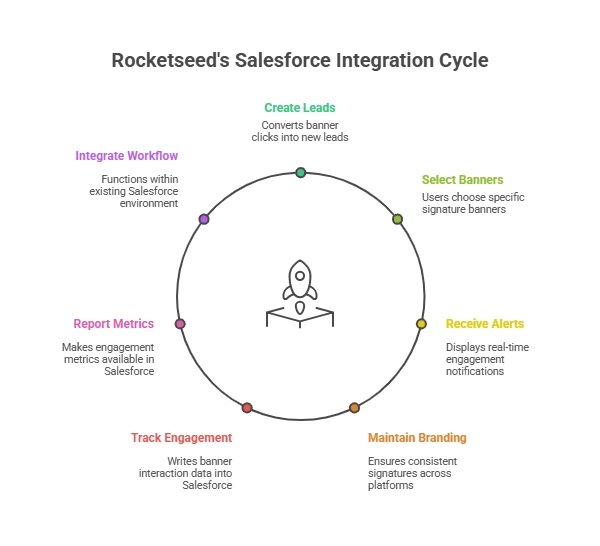
A standard signature shows contact information. A managed CRM-connected signature can support the sales workflow by adding controlled campaign banners, tracking engagement, and feeding useful signals back into the customer record.
Depending on the CRM and deployment model, this can help teams:
- see when a contact clicks a campaign banner
- connect signature engagement to leads or contacts
- choose campaign banners that match a sales stage or offer
- notify sales users while interest is fresh
- create cleaner reporting around email-driven campaign activity
- keep branding consistent across Outlook, Microsoft 365, Google Workspace, Exchange, and CRM-originated emails
The value is not just the click. The value is giving sales and marketing a better prompt for the next conversation.
Where businesses usually lose control
Without central management, signatures become inconsistent quickly. One salesperson uses an old promotion. Another removes the banner because it breaks on mobile. Someone adds an oversized graphic. A campaign link keeps running after the offer expires.
The CRM may also miss what happened. Marketing sees website traffic, sales sees inbox replies, and management sees only part of the funnel.
For a growing SMB, that creates two problems: weak brand control and weak visibility.
How Blue Chip would approach it
Before rolling out CRM-connected email signature marketing, Blue Chip would keep the project grounded in business process, not just software features.
We would help define:
- which CRM records should receive engagement history
- which campaigns are suitable for email signature banners
- who approves campaign artwork and links
- how sales users should follow up on clicks
- which teams need different banners or disclaimers
- how Microsoft 365, Google Workspace, Exchange, and mobile mail clients should behave
- what reporting is useful enough to review regularly
- how privacy, consent, and customer data handling should be documented
This is where managed IT and marketing operations need to work together. The tool can capture signals, but the business still needs rules for using them properly.
CRM integration should reduce manual work
If the process depends on CSV exports, manual updates, or users copying campaign links into their own signatures, it will not stay clean for long.
A better approach is central control: approved templates, directory-backed user details, scheduled campaign banners, consistent disclaimers, and CRM visibility where sales teams already work.
That gives the business a repeatable workflow instead of another one-off marketing task.
A practical sales use case
Imagine a managed services client sends monthly invoices, support updates, and account management emails. A signature banner promotes a cybersecurity assessment, Microsoft 365 review, backup check, or VoIP consultation.
When a customer clicks, the sales or account team can see interest in context and follow up with a relevant conversation. The email did not interrupt the customer, but it still created a measurable opportunity.
That is the practical value of CRM-connected signatures: they make normal business communication more useful.
The takeaway
Email signatures are already present in daily customer conversations. With Rocketseed, they can be centrally managed, campaign-ready, measurable, and connected to CRM workflows instead of being left as unmanaged Outlook or Gmail footers.
For Trinidad and Tobago SMBs, this is a sensible way to make sales and marketing follow-up more organised without asking staff to change how they send email every day.
Source: Rocketseed — Which is the best email signature software with Salesforce integration?.