
Companies that coordinate their AI agents through shared knowledge systems—what researchers call a "knowledge spine"—are seeing measurably stronger financial performance than those running scattered AI pilots. New research from Microsoft and Keystone, studying over 200 enterprises, found that organisations with these coordinated systems in place improved operating margins by more than 5 percentage points compared to those without. The key insight? What your AI agents learn on the job becomes proprietary intelligence that belongs to your company alone—but only if you've built the systems to capture and reuse it.
What exactly is a "knowledge spine" and why should you care?
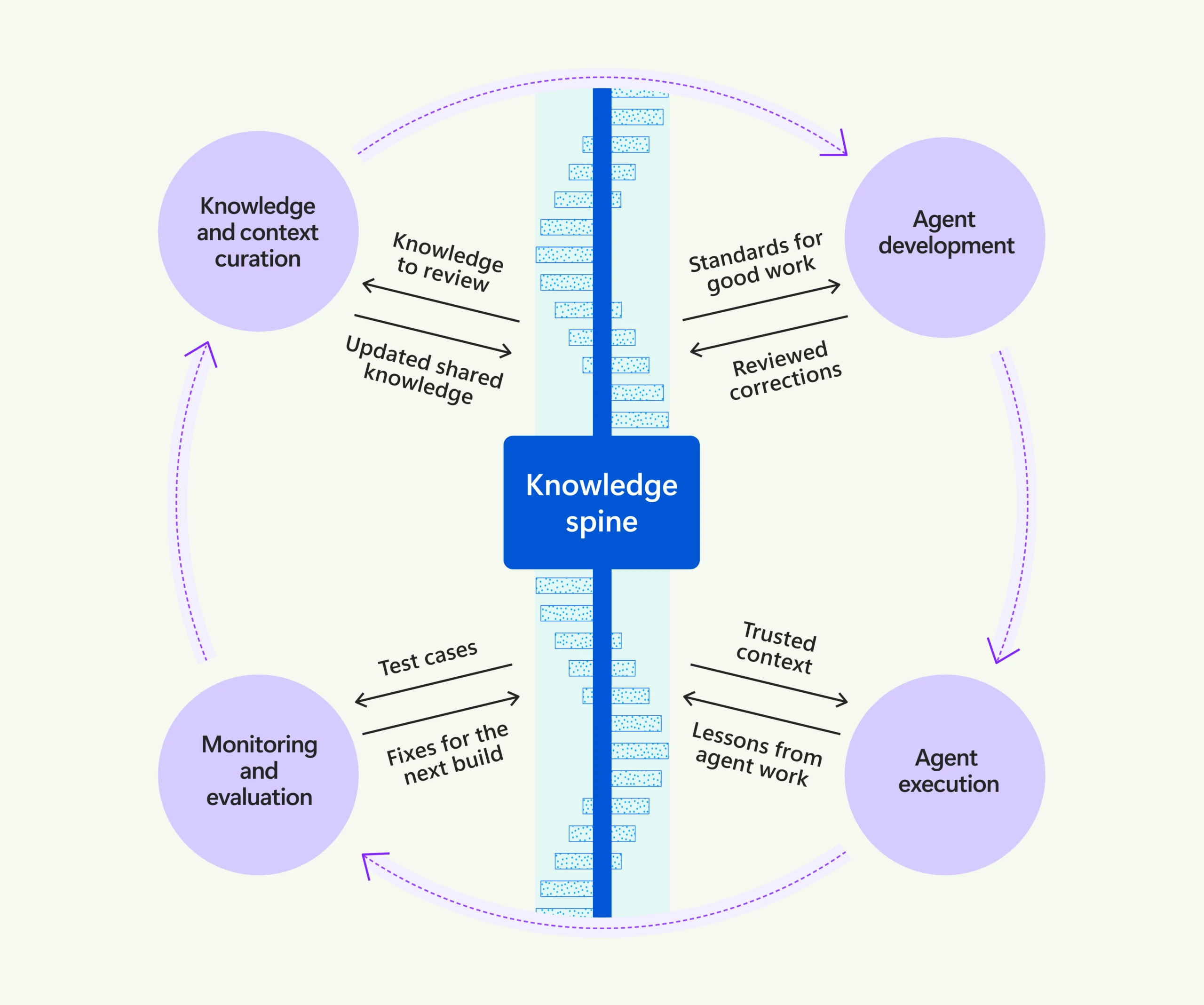
Think of it this way: most businesses running AI today have agents doing useful work in pockets—maybe one handling customer queries, another processing invoices, a third helping with sales forecasts. They're all learning things, making corrections, getting feedback from staff. But that knowledge stays siloed. It disappears.
A knowledge spine is the shared system that stores what your agents learn: the context they rely on, the corrections people make, the tests that prove something works. When one agent figures out that customers in a particular segment always ask about delivery times, that insight feeds back into the system. Other agents can use it. Your whole operation gets smarter.
Only about 3% of companies in the study have actually built this. But those that have are showing what's possible.
Where does Microsoft 365 fit into this?
Here's the practical bit. Microsoft 365 isn't just email and Word documents anymore—it's increasingly the foundation where this kind of coordinated AI work happens. Copilot runs across your Office apps, Teams conversations, SharePoint documents, and OneDrive files. That's your organisational knowledge, already in one place.
When you're thinking about building toward a knowledge spine, you need somewhere for that shared context to live. For most businesses, that's already Microsoft 365. Your documents, your communication history, your workflows—they're there. The question becomes how you connect your AI agents to that foundation and start capturing what they learn.
If you're still running older on-premises systems or a patchwork of different cloud tools, you're making this harder than it needs to be. Microsoft 365 Business subscriptions give you the unified platform where coordinated AI actually becomes practical.
What stage is your organisation at?
The researchers grouped companies into four stages. It's worth being honest about where you sit:
Stage 1: Scattered AI pilots, mostly chatbots, not connected to real business workflows. Minimal impact.
Stage 2: Agents tackling actual business tasks across different functions—but humans are still doing all the coordination and checking. This works, but it doesn't scale.
Stage 3: The turning point. Systems start coordinating agents instead of people. Maybe it's just in one department first, but the shift has begun.
Stage 4: Full orchestration, governance, and a knowledge spine in place. Lessons from agent work feed back into shared knowledge automatically.
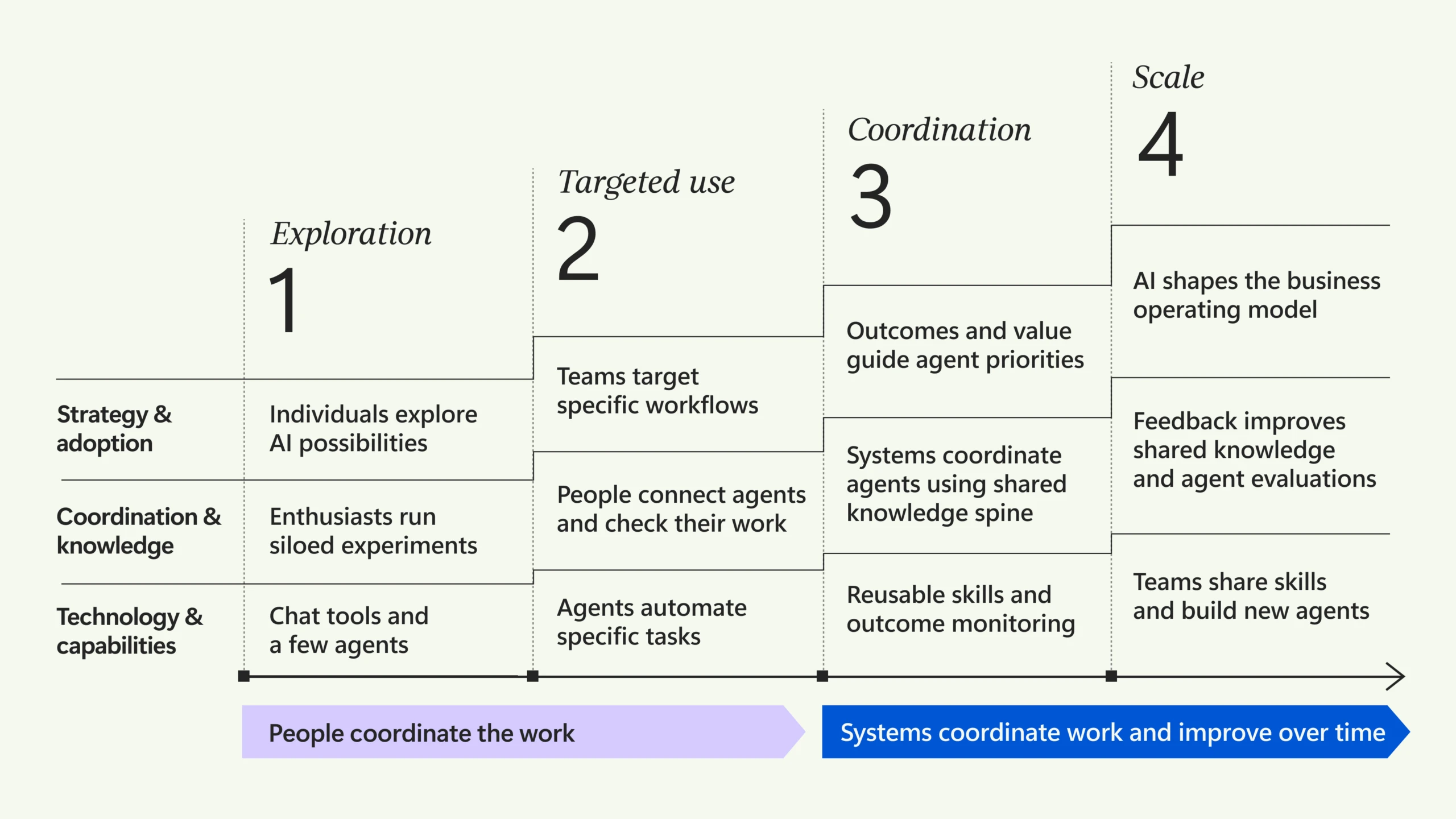
Most companies are somewhere between stages 1 and 2. The jump to stage 3 is where the financial returns start showing up clearly.
Why do some companies see returns while others don't?
The researchers point to something economists call the J-curve. When major technology arrives, performance often dips or stalls while you reorganise work around it—then climbs once those changes take hold.
With AI agents, the lag seems to come from deploying them faster than building the systems to coordinate them. You've got agents working, but they're not learning from each other. You're paying for the compute, but not capturing the compounding value.
The companies seeing margin improvements weren't necessarily using fancier AI. They'd built the coordination layer. They'd made the investment in connecting things up.
How do you actually start building toward this?
A few practical steps:
Consolidate your productivity platform. If your documents are in five different systems and your communication happens across three messaging apps, you're creating friction before you even begin. Microsoft 365 puts email, files, collaboration, and AI assistance in one environment.
Start with one workflow, not the whole company. The research found that stage 3 companies often began with a single department or a few key processes. Pick something with clear inputs and outputs where you can measure improvement.
Document what agents learn. This sounds obvious, but most organisations don't do it. When an agent gets corrected, when a human improves on its output—that's valuable. Capture it somewhere it can be reused.
Connect your agents to shared context. Copilot in Microsoft 365 already draws on your organisation's documents and communications. That's the beginning of a knowledge spine, even if you're not calling it that yet.
Frequently asked questions
Do I need to be using AI agents already to benefit from this approach?
Not necessarily. If you're using Copilot in Microsoft 365, you're already working with AI that draws on your organisational knowledge. The principles here—shared context, capturing corrections, coordinating AI work through systems rather than just people—apply whether you're running sophisticated autonomous agents or simply getting more from Copilot.
What's the difference between AI coordination and just having an IT team manage AI tools?
Human coordination means people are checking agent outputs, deciding what work agents should do, and manually sharing learnings across teams. System coordination means the infrastructure handles much of this automatically—agents share context, governance rules apply consistently, and lessons get captured without someone having to remember to document them. The second approach scales; the first hits a ceiling.
How long before we'd see financial returns from building these systems?
The research shows correlation over a 2022-2025 period, so we're talking years rather than months. The J-curve effect means you might see costs rise before returns materialise. That's normal. The companies that pushed through that phase are the ones showing margin improvements now.
Is Microsoft 365 enough, or do we need additional platforms?
For most small and mid-sized businesses, Microsoft 365 provides the foundation you need—unified documents, communication, and AI assistance in one place. Larger enterprises with complex agent deployments may need additional orchestration tools, but you'd build those on top of the Microsoft 365 foundation, not instead of it.
Ready to build your AI advantage?
At Blue Chip Technologies Ltd., we help businesses worldwide get Microsoft 365 set up properly—not just switched on, but configured so you can actually capture the value from AI coordination. Whether you're just moving to Microsoft 365 or looking to get more from Copilot, we can help you build the foundation for what comes next.
Get in touch:
- Call: 1 (868) 609-2288
- WhatsApp: Chat with us
- Email: [email protected]
- Online: bluechiptt.com/contact