
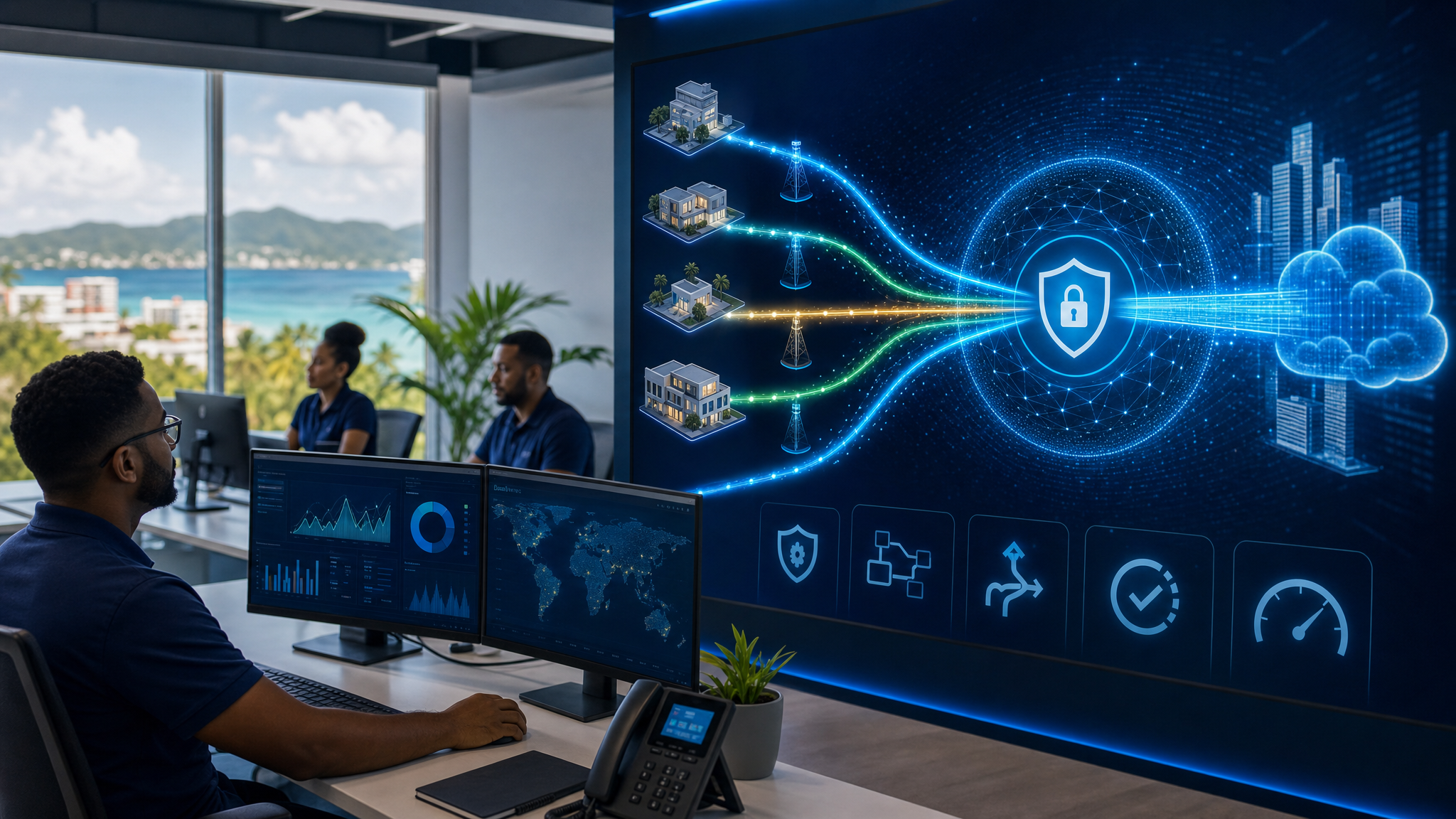
SD-WAN: Branch Connectivity Needs More Than Backup Internet
For businesses with more than one location, internet connectivity is not just an IT line item. It affects point-of-sale systems, email, VoIP, cloud apps, accounting, file access, remote support, security cameras, and the ability for staff to keep working when a link becomes unstable.
Many small and mid-sized businesses try to solve this with “backup internet.” That is a good start, but it is not the full answer. A second circuit only helps if traffic can fail over cleanly, sessions stay alive where possible, security policy remains consistent, and someone is monitoring what is actually happening.
GFI Software’s SD-WAN guidance explains the practical value of software-defined wide area networking: combining multiple internet access resources such as broadband, fibre, DSL, or cellular into a more resilient, centrally managed network. GFI also highlights features such as bonding multiple links, keeping application flows alive during WAN brownouts or blackouts, branch-to-head-office connectivity, and centralized control.
For Blue Chip clients, the lesson is straightforward: reliable branch connectivity needs design, monitoring, and support — not just another router plugged into the cabinet.
Backup internet is not the same as resilient connectivity
A business may have two internet lines and still experience downtime if the environment is not designed properly.
Common problems include:
- manual failover that depends on someone noticing the outage
- VoIP calls dropping when a circuit changes
- cloud applications losing active sessions
- firewall policies differing between the primary and backup paths
- staff connecting to the wrong Wi-Fi or unmanaged backup router
- no alerting when the primary link is down
- no reporting on which link is slow, saturated, or unstable
The result is a setup that looks redundant on paper but still causes disruption in real use.
SD-WAN addresses this by treating connectivity as a managed service layer. Instead of simply having two lines, the business can apply policy, steering, monitoring, and failover decisions across those links.
Why SD-WAN matters for branch offices
A branch office usually needs access to shared systems without feeling like a second-class location. Staff expect email, voice, cloud apps, inventory systems, accounting tools, and security systems to work consistently.
SD-WAN can help by:
- using multiple links together where appropriate
- steering important traffic over the best available path
- failing over when a link degrades or drops
- encrypting traffic between sites
- reducing dependency on expensive legacy WAN circuits
- giving IT a clearer view of link performance and branch health
This matters in Trinidad and Tobago because many businesses operate with a mix of offices, warehouses, retail locations, remote workers, and cloud services. Connectivity quality can vary by provider, location, building, and time of day. A resilient design must account for that reality.
Security still has to be part of the design
Connectivity and security cannot be separated.
If a backup line bypasses the main firewall, the business may accidentally create a weaker path into the network. If branch traffic is not segmented, one compromised device can affect more systems than necessary. If VPNs, DNS filtering, firewall rules, and logging are inconsistent, troubleshooting and incident response become harder.
A managed SD-WAN approach should include:
- firewall and access policy alignment
- encrypted site-to-site traffic where needed
- network segmentation for guest, staff, voice, camera, and business systems
- DNS and web filtering policies
- monitoring for unusual traffic patterns
- documented failover and rollback procedures
- regular review of provider performance and circuit health
The goal is not simply to keep traffic moving. The goal is to keep the right traffic moving safely.
The operational work matters as much as the product
SD-WAN is not a magic box. It works best when the surrounding operational process is clear.
Before recommending SD-WAN or any branch connectivity change, Blue Chip looks at questions such as:
- Which applications are business-critical?
- Which sites need access to which systems?
- What should happen during a primary internet outage?
- Which traffic needs priority: VoIP, POS, accounting, video, or remote support?
- Are existing firewalls, switches, Wi-Fi, and cabling ready?
- Who receives alerts when a circuit becomes unstable?
- How will the business know whether the provider is meeting expectations?
Those questions prevent expensive guesswork. They also help the business avoid overbuying connectivity while underinvesting in management.
When SD-WAN is worth considering
SD-WAN is worth reviewing when a business has:
- multiple branches or remote operating locations
- frequent internet instability or provider failover problems
- VoIP quality issues linked to connectivity
- important cloud applications that must stay available
- costly legacy WAN/MPLS services that need review
- limited visibility into branch traffic and link health
- a need to standardize security across sites
It may not be necessary for every small office. Sometimes a simpler firewall, better ISP arrangement, improved Wi-Fi, or cleaner cabling will solve the real problem. The point is to assess the environment before choosing the tool.
Blue Chip’s approach
Blue Chip helps businesses design branch connectivity as part of a wider managed IT plan. That includes reviewing circuits, firewalls, switches, Wi-Fi, VoIP, endpoint security, cloud access, monitoring, documentation, and support ownership.
For some clients, SD-WAN may be the right way to improve uptime and performance. For others, the first step may be fixing basic network design issues and adding proper monitoring. Either way, the objective is the same: fewer surprises, faster troubleshooting, and a network that supports how the business actually operates.
If your business relies on multiple locations, remote staff, cloud applications, or VoIP, do not wait for the next outage to review the design. Backup internet is useful. Managed resilient connectivity is better.
Source: GFI Software — What is SD WAN and how does it work?.