WhatsApp Calls Belong in the Business Phone System
Customers already use WhatsApp to reach suppliers, service providers, schools, clinics, retailers, contractors, and professional offices. For many Trinidad and Tobago businesses, WhatsApp is no longer a side channel. It is part of how customers expect to communicate.
The challenge is that WhatsApp calling can become messy when it lives outside the business phone system. Calls may ring on one handset, depend on one staff member, bypass queues, miss recording policies, or disappear from the normal support process.
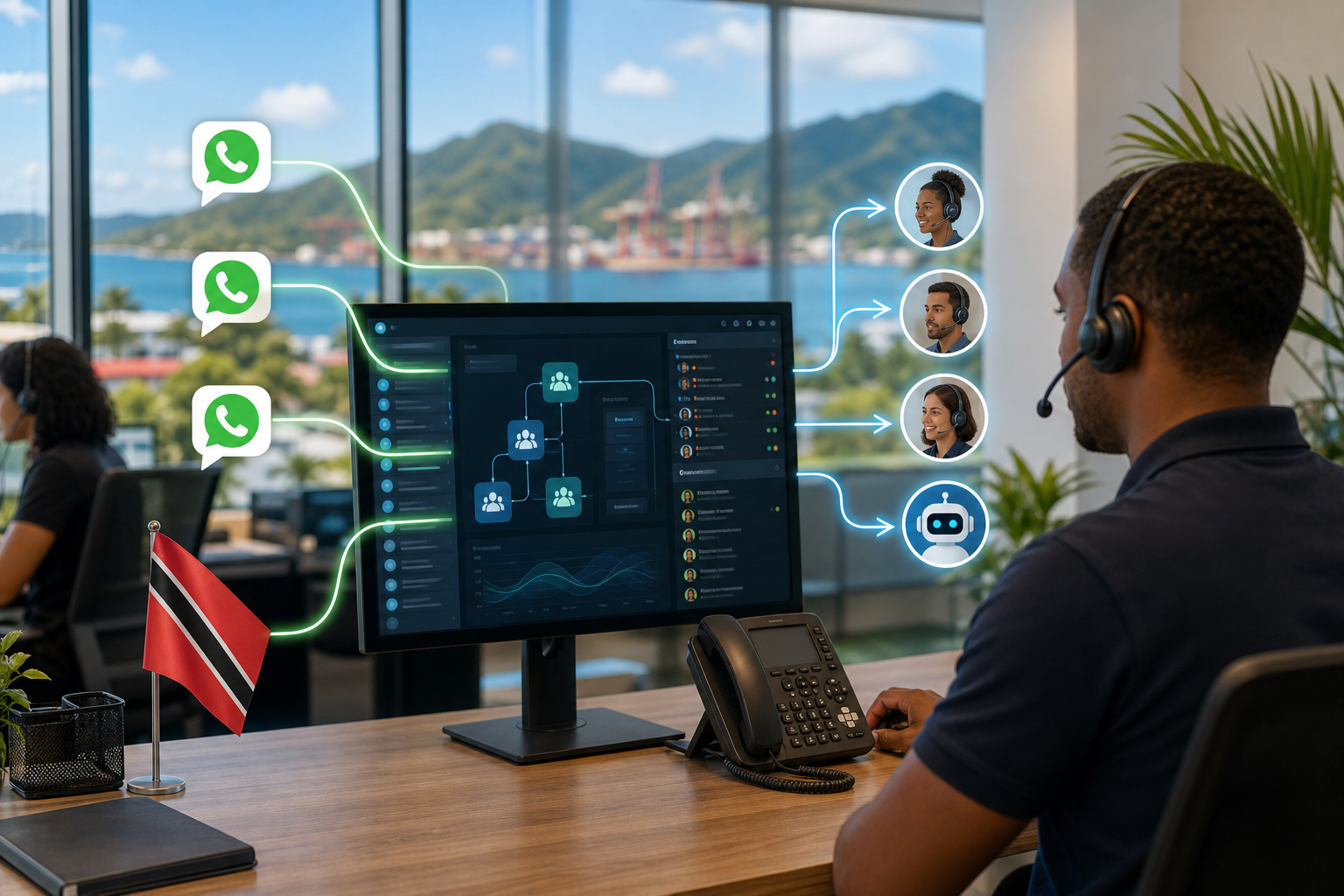
3CX recently highlighted WhatsApp Inbound Calls for V20 Update 8, allowing a WhatsApp number to be configured as a SIP trunk and routed through the PBX to extensions, queues, and AI Agents. For SMBs, the useful point is not novelty. It is control: WhatsApp calls can start to behave more like managed business calls.
Why this matters for local businesses
Many customers prefer WhatsApp because it is familiar, mobile-friendly, and often cheaper than a traditional call. A customer may not want to search for an office number or wait until they are at a desk. They want to tap a contact and speak to someone.
That convenience is good for sales and service, but only if the business can manage it properly.
When WhatsApp calling is separate from the PBX, common problems appear:
- one person becomes the bottleneck for customer calls
- missed calls are harder to see and report on
- handoffs between staff become informal
- customers may receive inconsistent answers
- managers lose visibility into call volume and response quality
- support teams cannot easily route calls by department or priority
- personal phones may end up carrying business conversations
Bringing WhatsApp inbound calls into 3CX helps solve those operational issues.
WhatsApp calls can follow real call flows
With a WhatsApp number connected as a SIP trunk, incoming calls can be routed in the same structured way as other business calls. That means a business can send calls to reception, sales, support, accounts, a call queue, an IVR, or an AI Agent depending on the process.
For a small business, that can mean:
- sales calls reach the team instead of one mobile phone
- support calls enter a queue with proper handling
- after-hours calls follow a documented route
- managers can adjust call flows without changing customer habits
- staff can answer through 3CX rather than personal WhatsApp accounts
- remote workers can still participate in normal call handling
The customer still uses WhatsApp. The business gets a more professional operating model behind it.
It strengthens customer experience without adding another silo
The worst version of business communication is a pile of disconnected channels: office phone, mobile numbers, WhatsApp chats, website chat, email, and social messages all handled separately.
3CX already brings voice, chat, queues, mobile apps, web client access, and integrations into one system. WhatsApp inbound calling fits that direction. It gives customers another convenient way to reach the business while keeping staff inside a managed workflow.
That is especially useful for teams that already use call queues, CRM notes, Microsoft 365 or Google Workspace contacts, remote work apps, and call reporting.
Configuration still matters
This is not something to switch on casually. WhatsApp SIP calling requires Meta setup, a WhatsApp application, SIP enablement on the WhatsApp number, correct provider template configuration, and testing before customers rely on it.
A proper rollout should answer practical questions:
- Which number should customers call on WhatsApp?
- Should WhatsApp calls go to sales, service, reception, or a dedicated queue?
- What should happen after hours?
- Should calls be recorded, and what consent notice is required?
- Which users are allowed to answer these calls?
- How are missed calls followed up?
- What happens if the internet link or PBX is unavailable?
- Who owns ongoing support and changes?
The business value comes from the process, not just the technical connection.
Security, policy, and privacy cannot be ignored
WhatsApp is familiar, but business calling still needs governance. Calls may involve customer details, account information, complaints, payments, appointments, or internal escalation.
Blue Chip recommends treating WhatsApp inbound calling as part of the official phone system policy:
- use approved numbers and accounts
- document call routing and ownership
- restrict administration access
- review recording and retention rules
- train staff on when to move from chat to voice
- monitor missed calls and queue performance
- keep the PBX, apps, and SIP settings maintained
This keeps convenience from turning into uncontrolled communication.
Where Blue Chip can help
Blue Chip supports businesses that use 3CX, VoIP, SIP trunks, call queues, mobile apps, and unified communications to serve customers more reliably.
For WhatsApp calling, we can help review whether the feature fits your environment, plan the call flow, configure 3CX routing, align the setup with existing queues and departments, test the experience, and document the support process.
For many SMBs, the goal is simple: let customers call in the way they prefer, while the business keeps control, visibility, and accountability.
WhatsApp calls should not depend on one phone in someone's hand. They should be part of a managed communications system.
Source: 3CX Blog - WhatsApp Inbound Calls.