
AI Security Tools Still Need a Managed Rollout
AI is being added to business software quickly. That is useful, but it also changes how small and medium-sized businesses should manage their security and network tools.
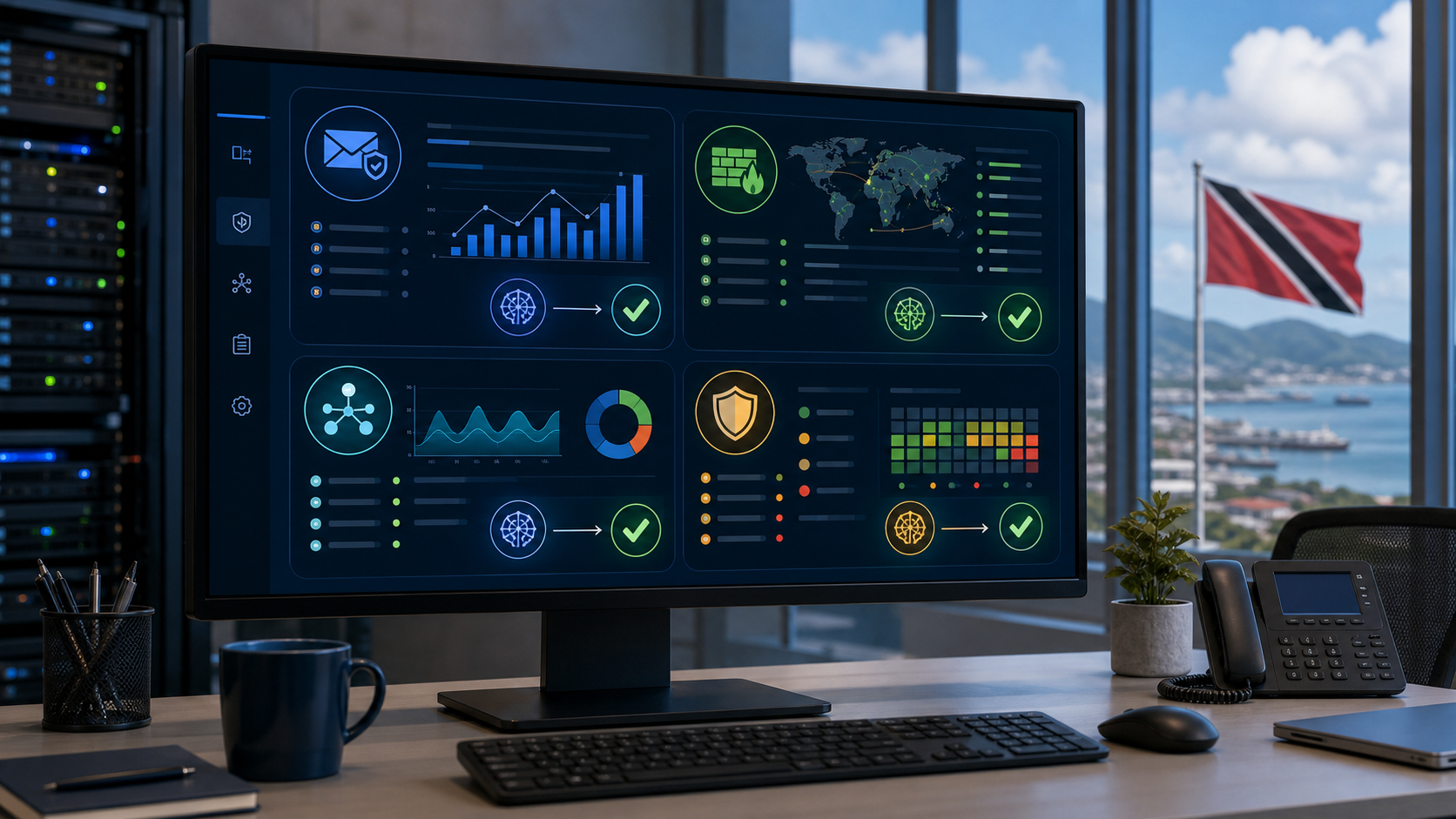
GFI Software recently announced CoPilot AI capabilities across four core products: GFI MailEssentials, GFI KerioControl, GFI ClearView, and GFI LanGuard. The announcement points to practical AI uses such as email security rule generation, firewall log insights, configuration optimization, network traffic analysis, and LAN security monitoring.
For Trinidad and Tobago SMBs, the important takeaway is not simply that AI features exist. The real question is whether those features are introduced with ownership, policy, review, and follow-up.
AI can reduce guesswork, but it needs context
Security tools already produce a lot of information. Email filters, firewalls, patching tools, endpoint protection, and network monitors all generate alerts, logs, recommendations, and reports.
AI can help turn that raw information into something more useful:
- suggested email security rules
- clearer firewall and traffic insights
- configuration recommendations
- unusual network behaviour detection
- faster review of patching and LAN risk
- simpler reports for managers and technical teams
That is valuable because most SMBs do not have a large security operations team watching every dashboard all day.
But AI recommendations still need business context. A suggested rule may make sense technically and still interrupt a workflow. A traffic spike may be malicious, or it may be a legitimate backup job. A firewall change may improve security, but it may also affect a branch office, payment system, remote user, or phone service.
The tool can assist. The business still needs a managed process.
Email security should not run on autopilot
GFI's MailEssentials AI direction is especially relevant because email remains one of the easiest ways to attack an SMB. Phishing, fake invoices, infected attachments, impersonation, and supplier payment-change scams all begin in the same place: the inbox.
AI-assisted rule generation can help adapt filtering to a company's location, industry, and compliance needs. That can be useful for businesses that see local supplier names, regional domains, and industry-specific phrases that a generic rule set may not understand well.
Blue Chip's view is that this should sit inside a broader email security plan:
- MFA for every mailbox
- spam and phishing filtering
- SPF, DKIM, and DMARC review
- mailbox forwarding and rule audits
- quarantine monitoring
- user training for invoice and payment scams
- backup or archiving where business records matter
- a clear incident process when a mailbox is suspected compromised
AI can make the filter smarter, but it should not be the only control.
Firewalls need review, not just more alerts
GFI KerioControl AI is positioned around log insights and configuration optimization. That matters because firewall configuration is often changed under pressure: a vendor needs access, a branch needs a VPN, a user complains a service is blocked, or a new system needs to go live.
Over time, rules can accumulate. Old VPN users remain active. Temporary openings become permanent. Logging is left too noisy or too quiet. Bandwidth controls drift away from the actual business priority.
AI-assisted firewall review can help surface patterns and recommendations, but the final decision should be tied to business intent:
- Which users and systems actually need remote access?
- Are rules still linked to a current business purpose?
- Is traffic being inspected and logged at the right level?
- Are voice, cloud, and payment systems being protected from congestion?
- Are risky categories and applications handled consistently?
- Is there a documented rollback path before changing production rules?
That is where managed IT discipline matters.
Network visibility needs action behind it
GFI ClearView AI and GFI LanGuard AI point toward a wider operational issue: visibility is only useful when someone owns the response.
A dashboard may show unusual traffic. A vulnerability tool may show missing patches. A network monitor may show a failing device. Those signals matter only if they lead to action: triage, prioritization, remediation, documentation, and verification.
For an SMB, that usually means deciding:
- which alerts are urgent
- who reviews them
- what gets patched immediately
- what waits for a maintenance window
- which devices are unsupported or risky
- which findings should become management decisions
- how completed work is verified
AI can help sort the noise, but it cannot replace accountability.
The right rollout starts small
Businesses do not need to enable every AI feature at once. A better approach is to choose a narrow use case, define success, and review the result.
Good starting points include:
- using AI-assisted email filtering recommendations for one business unit
- reviewing firewall configuration suggestions before applying any changes
- using network traffic insights to identify recurring congestion
- using LAN monitoring findings to improve patching priorities
- turning AI-generated reports into monthly management review notes
The goal is controlled improvement, not a sudden blind handover to automation.
The Blue Chip view
AI-enabled security and network tools are useful when they help the business see risk earlier, understand systems faster, and respond with better evidence. They are risky when they are treated as a magic switch.
Blue Chip can help assess where GFI tools such as MailEssentials, KerioControl, ClearView, LanGuard, and AppManager fit into your environment. More importantly, we can help define the operating process around them: who reviews alerts, who approves changes, how exceptions are handled, and how improvements are verified.
For Trinidad and Tobago SMBs, the practical benefit is straightforward: better visibility, fewer blind spots, and a more disciplined path from recommendation to action.
Source: GFI Software, GFI Integrates AI Capabilities Into Four Core Products.