Microsoft's new Work IQ APIs let AI agents interact directly with your Microsoft 365 data—emails, calendars, files, chats, and collaboration patterns—so they can retrieve context, take actions, and work on behalf of your team without needing a human to drive every step. The APIs go generally available on 16 June 2026, and they're built specifically for the way agents operate: high-frequency, multi-step tasks that need speed, security, and real business context rather than raw data dumps.
If your organisation is building or deploying AI agents that need to work with Microsoft 365, this is the interface Microsoft wants you to use going forward.
Why should your business care about Work IQ APIs?
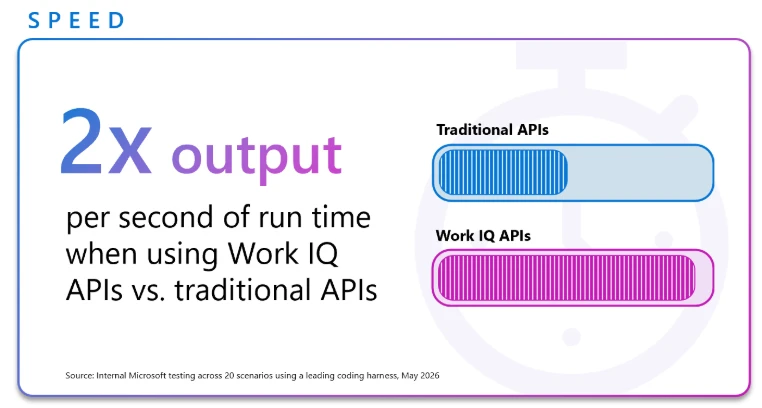
Here's the practical bit: traditional APIs were designed for humans clicking through apps. Agents don't work that way. They need to pull context fast, act on it, and move on—often executing dozens of operations in the time it takes someone to read an email.
Work IQ APIs are purpose-built for that pattern. They sit on top of a semantic index that understands your organisation's structure, collaboration patterns, and business knowledge. Instead of returning raw data your agent has to interpret, Work IQ packages context in a format agents can actually use.
The result? Your agents get better answers, faster, with fewer tokens burned.
What can agents actually do with these APIs?
The API set breaks down into four domains:
Chat – Programmatic access to Microsoft 365 Copilot's full capabilities. Your agent can ask questions and get the same responses (with citations) that a user would see.
Context – Retrieves the content Copilot would use to answer a query, but returns it raw for your agent to process however it needs.
Tools – A simplified set of actions: send emails, schedule meetings, upload documents. Ten generic tools instead of hundreds of data-specific ones.
Workspaces – Secure storage within your Microsoft 365 tenant where agents can stash intermediate data while working through multi-step tasks.
That last one matters more than it sounds. Long-running agents need somewhere to keep their working state, and keeping it inside your tenant boundary means you're not shipping sensitive data off to some third-party service.
How does this affect token costs and efficiency?
This is where it gets interesting for anyone watching their AI spend.
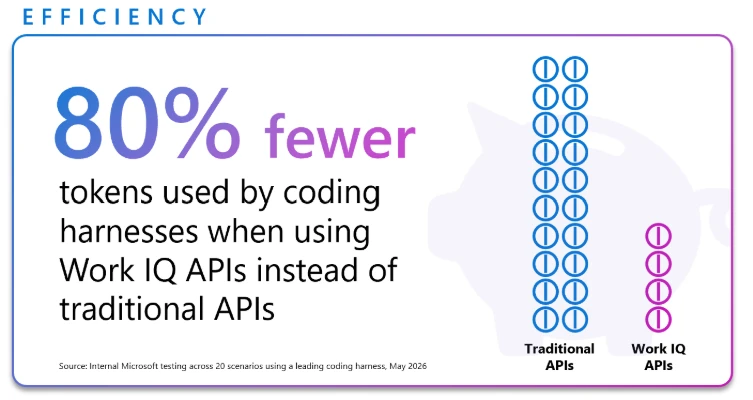
Work IQ moves more AI processing into Microsoft's runtime rather than your orchestration layer. It trims unnecessary metadata—file record strings, message IDs, app IDs—before returning results. The practical effect: fewer tokens to retrieve the same context.
Microsoft's also launching a cost management dashboard in the Microsoft 365 admin centre. IT admins can review credit usage, set spending limits by tenant, group, or user, and choose between prepaid or pay-as-you-go billing. If you've ever had a runaway automation blow through your budget, you'll appreciate that level of control.
What about security and compliance?
Agent operations stay within your Microsoft 365 tenant trust boundary. Data doesn't leave. Actions are auditable and discoverable through your existing compliance tools.
That's a significant point for regulated industries or any organisation that's been hesitant about AI agents accessing sensitive business data. You're not bolting on a separate governance layer—it's built into how Work IQ operates.
How do you get started?
The public preview is available on GitHub now. General availability hits 16 June 2026.
If you're already working with Microsoft 365 and Copilot, this is worth exploring before the GA date. Understanding how Work IQ fits your automation strategy now means you won't be scrambling later.
Frequently asked questions
Do I need Microsoft 365 Copilot to use Work IQ APIs?
The APIs are designed to work with Microsoft 365 data and integrate with Copilot capabilities. Your specific licensing requirements will depend on which API domains you use—check Microsoft's documentation for current details.
What's the pricing model?
Work IQ APIs use usage-based pricing denominated in Copilot Credits. Tools have a fixed component; Chat and Context are variable. Microsoft hasn't published specific rates in this announcement.
Can I control which agents access what data?
Yes. IT admins can set spending limits and access controls at the tenant, group, and user level through the new cost management dashboard in the Microsoft 365 admin centre.
Is this available in preview now?
Yes, the public preview is on GitHub. General availability is 16 June 2026.
Ready to explore Work IQ APIs for your organisation?
Blue Chip Technologies Ltd. helps businesses worldwide get more from Microsoft 365—whether that's setting up your tenant, configuring Copilot, or planning how AI agents fit into your operations. We deliver remotely to clients globally and provide on-site support in Trinidad & Tobago.
Let's talk about what Work IQ could do for your team.
- 📞 Call: 1 (868) 609-2288
- 💬 WhatsApp: Chat with us
- 📧 Email: [email protected]
- 🌐 Contact form: bluechiptt.com/contact