A WhatsApp voice call is more private than a traditional landline or mobile call. That's not marketing—it's how the technology works. WhatsApp uses end-to-end encryption, meaning neither the carrier nor WhatsApp itself can listen to your conversation. A landline call travels unencrypted across the carrier's network, and a mobile call is decrypted at carrier infrastructure. For businesses handling confidential information—medical records, legal advice, financial details—that difference matters.
The short answer
Yes, WhatsApp voice calls offer stronger privacy than landlines or standard mobile calls. The audio is encrypted from your device to the other party's device, with no point in between where the carrier or WhatsApp can access it. But privacy isn't just about encryption. It's also about who answers, who sees the call history, and who controls the recordings. That's where running WhatsApp calls through a proper phone system changes things.
Landline, mobile and WhatsApp — three different levels of protection
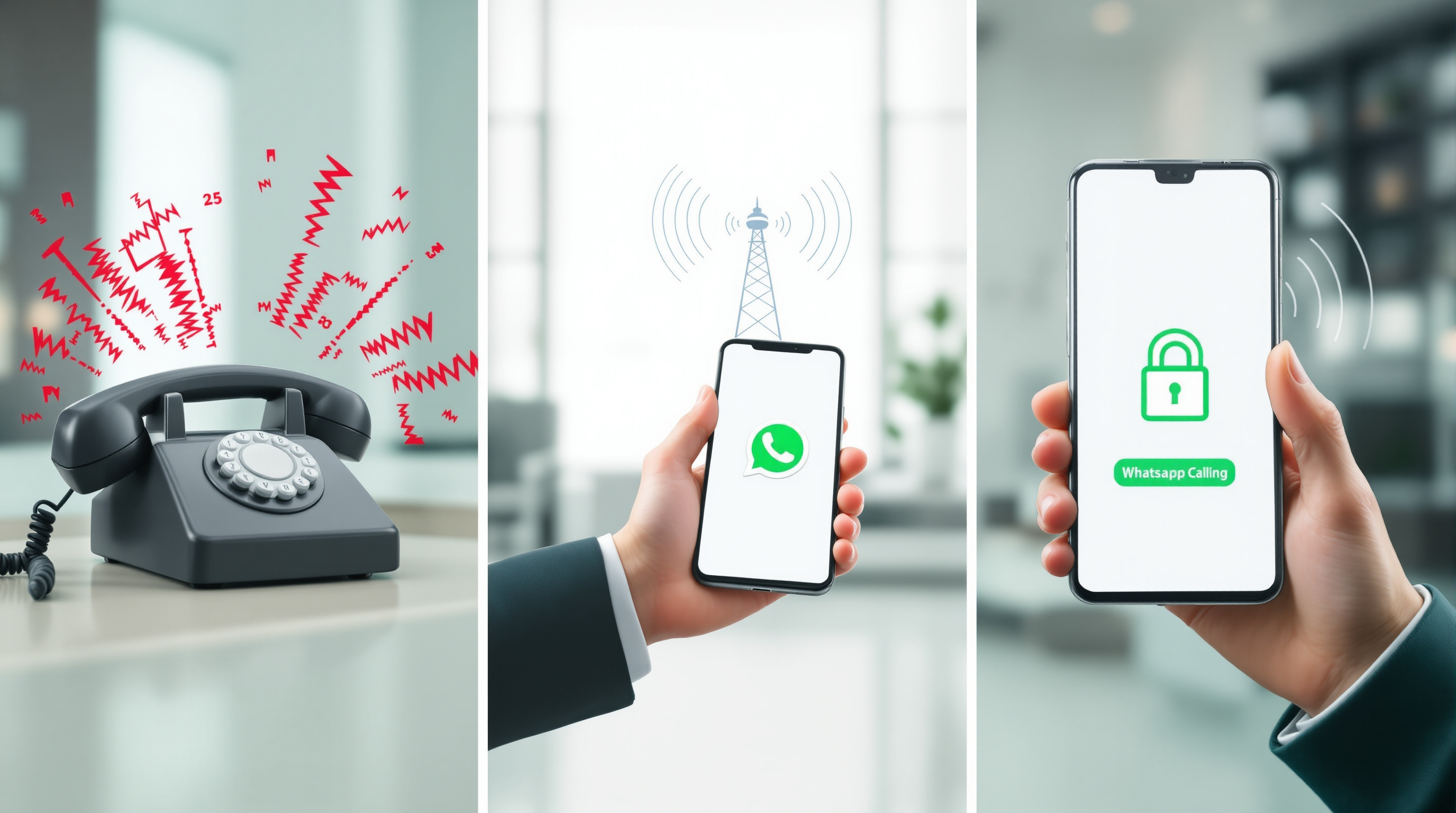
Here's what actually happens with each type of call:
Traditional PSTN landline: Voice travels in the clear across the carrier's network. There's no encryption. The audio can be intercepted at any tap point along the way. This technology dates from an era when wiretapping required physical access to a junction box—security through obscurity, essentially.
Standard mobile call (GSM or VoLTE): Better. The call is encrypted between your handset and the cell tower. But once it reaches carrier infrastructure, it's decrypted and travels unencrypted between carriers. The carrier network itself can access the audio. Law enforcement or insider access at carrier level is straightforward.
WhatsApp voice call: End-to-end encrypted between the two parties. The audio is encrypted on your device and only decrypted on the recipient's device. Neither the mobile carrier nor WhatsApp's servers can listen. This is a documented technical property of the Signal Protocol that WhatsApp uses.
For a legal firm discussing case strategy, a medical practice confirming test results, or an accountant reviewing someone's tax position, that progression from "no encryption" to "carrier-accessible encryption" to "end-to-end encryption" is worth understanding.
Where that protection ends when the call reaches your phone system
Here's where we need to be precise, because this is easy to overclaim.
When you bridge a WhatsApp call into your office phone system using SIP for WhatsApp, the leg between the gateway and your PBX is protected by SIP-TLS and DTLS-SRTP with trusted SSL certificates. That's strong transport encryption—the same standard used for secure VoIP generally.
But it is not the same as WhatsApp's end-to-end encryption. Once the call enters your PBX, it's handled like any other SIP call on your system. The encryption protects the call in transit between gateway and PBX, but the PBX itself processes the audio.
This isn't a weakness unique to bridging WhatsApp—it's how every phone system works. The question is whether your phone system is under your control, with your security policies, your access rules, and your recording retention settings. Which brings us to the bigger point.
Encryption is only half of confidentiality
Think about what confidentiality actually requires:
- Who can answer the call? On a personal mobile, whoever picks up the phone. On a PBX, only authorised extensions in a defined ring group or queue.
- Where does the call history sit? On a personal device, it's in that person's WhatsApp app, on their phone, synced to their personal backup. On a PBX, it's in your CDR system, under your retention policy.
- Who holds the recording? If you record calls for compliance or training, where do those files live? Who can access them? Are they encrypted at rest?
- What happens when someone leaves? If a staff member handled sensitive calls on their personal WhatsApp, that history walks out the door with them. If calls ran through your PBX, the records stay with the organisation.
Encryption protects the call while it's happening. Access control protects everything before and after.
What this means if you handle sensitive information
If your business routinely discusses personal data, health information, legal matters, financial details, or identity documents over the phone, you probably have obligations around confidentiality, access control, and record-keeping. These vary by country and sector—[verification required] for your specific situation—but the general principle is consistent: you need to know who accessed what, and you need to be able to demonstrate that.
A single WhatsApp app on someone's mobile doesn't give you that. You get one call at a time, one person able to answer, no queue, no transfer, no business-hours routing, and no centralised record of what happened. The call itself might be well-encrypted, but everything around it is uncontrolled.
The fix isn't to stop using WhatsApp—your clients already have the number saved, and they prefer it. The fix is to bring those calls into a system you actually manage.
Controlling the channel, not just the call
Blue Chip SIP for WhatsApp bridges WhatsApp voice calls into your existing IP PBX. The business keeps the same WhatsApp number. Clients keep calling the way they always have. But now:
- Inbound calls ring desk phones and softphones as ordinary extensions
- Calls route to ring groups, queues, or specific extensions based on your rules
- Blind or attended transfer between staff, with presence so calls reach people who are available
- Call recording, CDR, and reporting policies you've already configured apply automatically
- Business-hours schedules and after-hours announcements work properly
- Multiple simultaneous calls on the same WhatsApp number—capacity sized in blocks of 2, minimum 2 concurrent calls per number. Regular WhatsApp apps handle one call at a time.
The system works with 3CX, Asterisk/FreePBX, PortSIP, and similar SIP-based platforms. You can self-host (linking your own device and number to the gateway) or have Blue Chip Technologies Ltd. host and manage it for you.
Frequently asked questions
Is a WhatsApp call actually more secure than a mobile call?
For the call itself, yes. WhatsApp uses end-to-end encryption—the audio is encrypted on your device and only decrypted on the recipient's device. A standard mobile call is encrypted to the cell tower but decrypted at carrier infrastructure.
Does bridging WhatsApp into my PBX remove the encryption?
The WhatsApp leg remains end-to-end encrypted. The leg between the gateway and your PBX uses SIP-TLS and DTLS-SRTP transport encryption. This is strong protection, but it's not the same as WhatsApp's end-to-end encryption.
Can I handle multiple WhatsApp calls at once with this setup?
Yes. Regular WhatsApp apps typically handle one call at a time per number. The SIP bridge supports simultaneous calls on the same number, sized in blocks of 2.
What do I need to get started?
A SIP-compatible IP PBX, your existing WhatsApp number, and a decision on whether to self-host or use managed hosting. The solution page explains both options.
Blue Chip Technologies Ltd., based in Trinidad & Tobago with local support available there, can walk you through how SIP for WhatsApp fits your setup. If you'd rather just talk it through, get in touch:
- Phone: 1 (868) 609-2288
- WhatsApp: wa.me/18686092288
- Email: [email protected]
- Contact page: bluechiptt.com/contact